
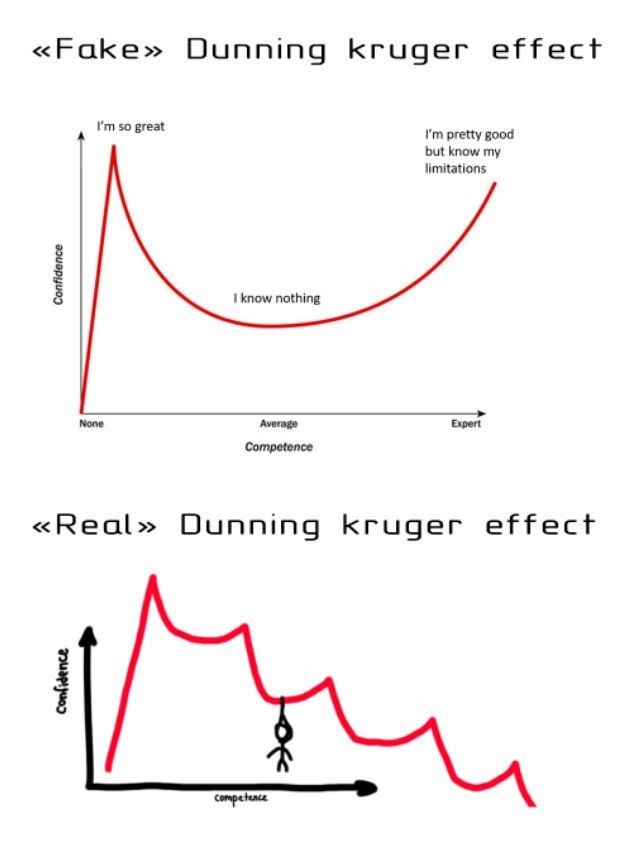
The Dunning-Kruger Rollercoaster
Description
This two-panel meme contrasts the 'Fake' and 'Real' Dunning-Kruger effect. The top panel shows the classic, simplified graph: a sharp peak of confidence at 'None' competence ('I'm so great'), a deep trough at 'Average' competence ('I know nothing'), and a gradual rise to 'Expert' competence ('I'm pretty good but know my limitations'). The bottom panel, labeled '«Real» Dunning kruger effect', depicts a much more chaotic and volatile graph. The red line of confidence repeatedly peaks and crashes, with a stick figure shown hanging by a noose from one of the troughs. This darkly humorous version suggests that the journey to expertise is not a smooth curve but a relentless, psychologically brutal cycle of fleeting confidence and crushing self-doubt. For senior developers, this 'real' version is deeply relatable, reflecting the constant struggle with imposter syndrome, the discovery of new 'unknown unknowns' in complex systems, and the emotional toll of a career in a rapidly changing field



Comments
7Comment deleted
The classic Dunning-Kruger graph is for your first programming language. The 'real' one is for when you're a decade in and have to learn Kubernetes, Terraform, and the entire AWS ecosystem at the same time
Real dev growth: confidence rockets after dockerising ‘hello-world’, nose-dives when Kubernetes asks for a readiness probe, spikes after pasting the StackOverflow YAML, then face-plants when the Istio sidecar triples latency - turns out the stick figure is just my pager hanging there
After 20 years in tech, I've learned that true expertise is just knowing exactly which Stack Overflow answer won't work in production and being able to articulate why in the post-mortem
The real Dunning-Kruger curve in software engineering looks less like a smooth U-shape and more like your production monitoring dashboard during a deployment - brief moments of confidence followed by cascading drops as you discover yet another edge case, legacy integration, or architectural decision that seemed brilliant at 2 AM but now haunts your code reviews. That stick figure? That's you at year 15, finally understanding that the more you know, the more you realize the entire industry is held together by duct tape, Stack Overflow answers from 2012, and the collective prayer that nobody touches the authentication service
Dunning - Kruger for distributed systems: confidence peaks at “just put it behind Kafka,” nosedives at “exactly-once,” bumps on idempotency, then digs a crater when GDPR meets event sourcing - right where your pager rings
Real Dunning-Kruger for 20-YoE architects: Peaks at system design doc, infinite valleys every time CAP theorem bites in prod
Experience is the cumulative sum of postmortems; by Staff level, the only thing you ship without a feature flag is skepticism