
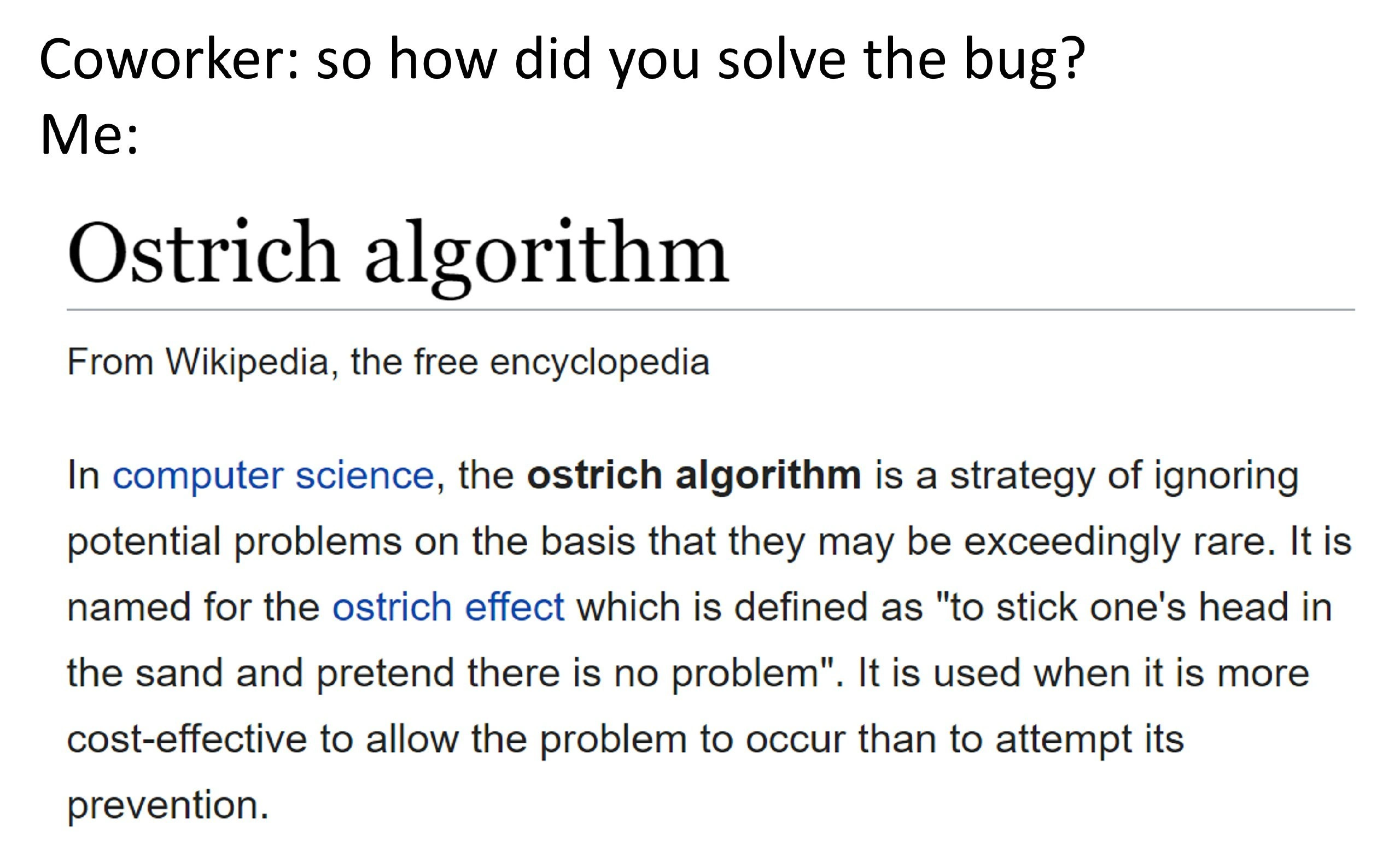
The Ostrich Algorithm: A Bug's Life
Description
A two-part meme. The top text reads "Coworker: so how did you solve the bug? Me:". Below this is a screenshot of a Wikipedia article titled "Ostrich algorithm". The article text defines the algorithm as "a strategy of ignoring potential problems on the basis that they may be exceedingly rare... It is used when it is more cost-effective to allow the problem to occur than to attempt its prevention." The joke lies in applying a formal computer science term to the common, and sometimes necessary, practice of deliberately not fixing a bug. For experienced developers, this is a humorous take on the pragmatic, and often unglamorous, reality of software maintenance, where triaging issues and managing technical debt sometimes means choosing to let rare bugs persist rather than expending significant resources to fix them

Comments
10Comment deleted
Our official policy for handling Heisenbugs is the Ostrich Algorithm, but we call it 'non-deterministic feature deferral' to make it sound more expensive
Deployed an enterprise-grade Ostrich Algorithm: wrapped the one-in-a-million deadlock in a try/catch that just bumps a Prometheus counter nobody alerts on - instant compliance, zero effort
After 20 years in the industry, you realize the ostrich algorithm is just a fancy name for 'mark it as won't fix' with a probability analysis attached - except now you can cite Wikipedia when the postmortem committee asks why you didn't handle that one-in-a-million race condition that took down production on Black Friday
Ah yes, the ostrich algorithm - a time-honored approach in production systems where the MTBF is just high enough that you'll have moved to a different team before the incident occurs. It's the architectural pattern that pairs beautifully with 'works on my machine' and 'we'll fix it in the next sprint.' Senior engineers recognize this as the unspoken foundation of many legacy systems: not technical debt, but technical willful ignorance - where the cost of the fix exceeds the probability-weighted cost of failure, at least until it becomes someone else's pager duty
How’d I fix it? Ostrich algorithm: rebranded the bug as acceptable risk, let the error budget pay for it, and tweaked the SLO until it stopped paging
Ostrich algorithm: where ignoring tail latencies beats O(n) Heisenbug hunts with provably better asymptotics
Implemented the Ostrich pattern: proved the bug’s probability fits our SLO’s error budget, reclassified it as accepted risk, and shipped - finance calls it cost optimization, SRE calls it Tuesday
aka "If i ignore it, maybe it will go away" Comment deleted
This is the ALARP principle - 'As Low As Reasonably Practicable' in risk-management context. One just stop putting in more resources when it's not worth to do so Comment deleted
UUIDs Comment deleted