
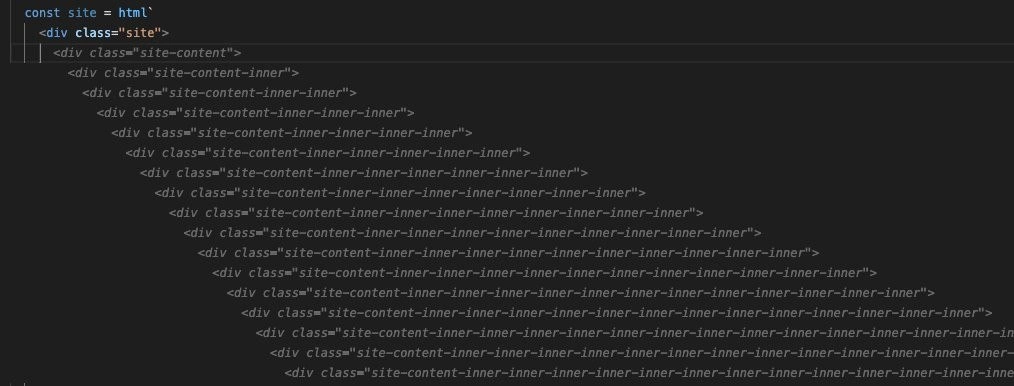
Frontend Development's Descent into Div-Itis Madness
Description
A screenshot of a code editor reveals a JavaScript template literal defining an HTML structure. The code illustrates an extreme case of 'div-itis,' where `<div>` elements are nested excessively. Starting with `<div class="site">`, each subsequent div is nested inside the previous one with an increasingly long class name, formed by appending '-inner' repeatedly. The class names quickly become absurd, such as 'site-content-inner-inner-inner-inner' and continue to grow, cascading down the screen in a pyramid of indentation. This meme satirizes poor HTML practices, the over-reliance on generic `<div>` containers, and the resulting deeply nested DOM tree that is a nightmare for styling, performance, and maintenance. It's a humorous exaggeration of the architectural problems frontend developers often encounter in legacy codebases or from inexperienced colleagues


Comments
7Comment deleted
The CSS selector for the innermost div is just `div > div > div > ...` until you run out of stack space on your keyboard
Somewhere around site-content-inner-17 I realised we’d basically reimplemented the call stack in HTML and were now relying on Chrome’s garbage collector for tail-call optimisation
When you realize the junior dev who wrote this was just trying to avoid CSS specificity wars and now you need a breadcrumb trail just to find where the actual content lives
When your CSS framework's 'container-wrapper-inner' pattern becomes sentient and starts reproducing. This is what happens when you let a junior dev loose with BEM notation and no code review - each div is a cry for help, wrapped in another div that's also crying for help. The real kicker? Somewhere in production, there's a CSS file with 47 levels of specificity trying to target that innermost div, and the only way to override it is with !important!important!important
Nesting so deep, your DOM traversal rivals a COBOL parser - blessed be the dev who wields CSS Grid
Wrapper-Oriented Architecture: every misaligned pixel gets another “site-content-inner”; specificity finally wins, the render pipeline loses, and the screen reader starts narrating “Entering inner… inner… inner…”
This isn’t a layout - it’s our governance model: one wrapper per reorg, where CSS specificity doubles every sprint and event delegation is O(depth)