
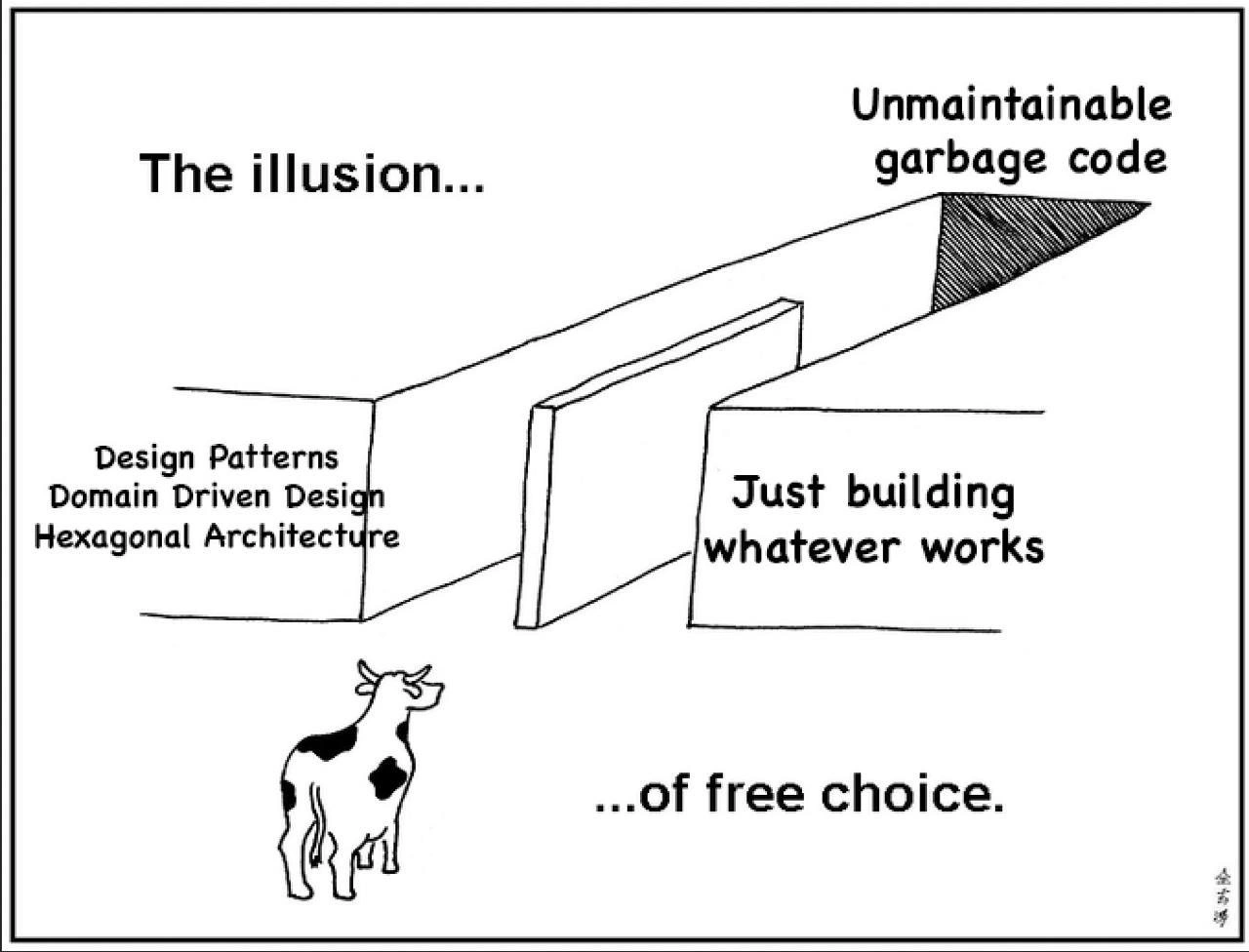
The Inevitable Path to Unmaintainable Code: An Illusion of Choice
Description
A black-and-white cartoon illustrating the futility of software development choices. The scene depicts a cow standing before two seemingly different pathways. The left path is labeled with sophisticated software engineering principles: "Design Patterns, Domain Driven Design, Hexagonal Architecture." The right path is labeled with a more pragmatic approach: "Just building whatever works." The visual punchline is that both paths converge into a single, narrow channel that leads to a dark, ominous destination labeled "Unmaintainable garbage code." The text at the top, "The illusion...", and at the bottom, "...of free choice.", frames the entire cartoon. This meme is a cynical but relatable commentary on the lifecycle of software projects. It suggests that regardless of whether a team starts with a highly structured, architectural approach or a quick-and-dirty, results-oriented one, the eventual outcome is often the same: a codebase that is difficult to maintain. For experienced developers, this resonates deeply, acknowledging that factors like deadlines, changing requirements, and team turnover can erode even the best architectural intentions, leading to an accumulation of technical debt. The humor lies in its fatalistic perspective on software entropy, suggesting that the struggle against chaos is a universal and perhaps unwinnable one

Comments
11Comment deleted
The road to technical debt is paved with good intentions and emergency hotfixes. You can start with hexagonal architecture, but you'll always end up at the spaghetti junction
Whether you call it Hexagonal, Layered, or ‘ship-it-now’, the code still collapses into the same shape as the org chart - Conway’s Funnel straight to legacy
After 20 years of arguing about microservices vs monoliths, event sourcing vs CRUD, and functional vs OOP, we've finally discovered the universal constant: every codebase eventually becomes that one service nobody wants to touch during on-call rotation
Every architect's nightmare: spending months designing a pristine hexagonal architecture with perfect domain boundaries, only to discover the production system is held together by a 500-line God class someone wrote on a Friday afternoon that 'just works' and nobody dares refactor because it processes $10M in transactions daily
DDD and hexagonal vs “just ship it” feels like a choice, but org entropy is a funnel - both paths end at helpers.ts glued to a shared DB; you only get to pick the buzzword in the README
DDD and hexagonal or YOLO - without time for tests and refactoring, you just ship the same pattern: Legacy on Day One
Hexagonal DDD: where your domain model's safe from I/O ports - until 'whatever works' prototypes ship faster and own prod
As I've told before: Comment deleted
No methodology can save one from doing shit if he is shitty dev Comment deleted
bullshit, through my career I worked with many different projects, and there is big difference in result after making this choice. I saw projects that had to be rewritten many times, and on the other side, which was supported in maintainable state for years. Comment deleted
The design pattern was chosen based in initial spec. Too bad that the specifications are not set in stone. Also bringing in juniors to maintain a project they have never seen while moving the lead (and only) dev to new tasks means it will be enshittified sooner or later. Comment deleted