
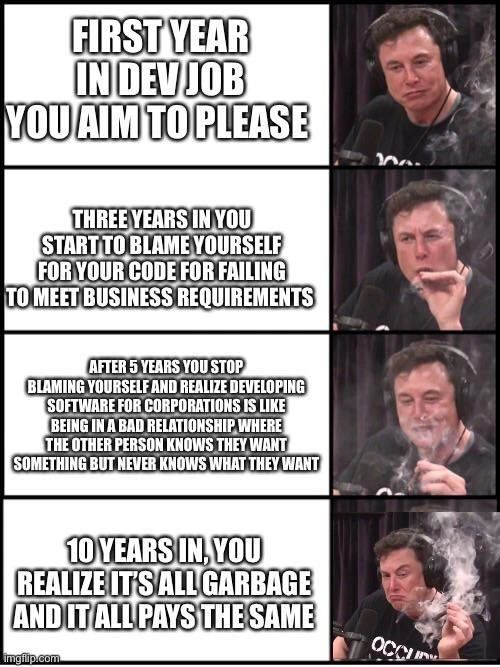
The Four Stages of a Corporate Developer's Career
Description
A four-panel meme that charts the evolving cynicism of a software developer over a decade. Each panel on the left has text describing a career stage, paired with a panel on the right showing Elon Musk during a podcast, with his expression and actions escalating in intensity. First panel: 'FIRST YEAR IN DEV JOB YOU AIM TO PLEASE' shows a neutral Musk. Second panel: 'THREE YEARS IN YOU START TO BLAME YOURSELF FOR YOUR CODE FOR FAILING TO MEET BUSINESS REQUIREMENTS' shows Musk lighting a cigar. Third panel: 'AFTER 5 YEARS YOU STOP BLAMING YOURSELF AND REALIZE DEVELOPING SOFTWARE FOR CORPORATIONS IS LIKE BEING IN A BAD RELATIONSHIP WHERE THE OTHER PERSON KNOWS THEY WANT SOMETHING BUT NEVER KNOWS WHAT THEY WANT' shows Musk exhaling a small amount of smoke. Fourth panel: '10 YEARS IN, YOU REALIZE IT'S ALL GARBAGE AND IT ALL PAYS THE SAME' shows Musk exhaling a massive cloud of smoke, looking completely checked out. The meme captures the journey from eager junior to disillusioned senior engineer, worn down by vague requirements, corporate dysfunction, and the realization that many projects are ultimately ephemeral or meaningless

Comments
9Comment deleted
The final stage is architect, where you realize it's all garbage, but now you get paid more to draw diagrams of the garbage before anyone else writes it
After 10 years I finally found the real singleton in our architecture: the salary band table - immutable, highly available, and totally untouchable
The real 10-year milestone is when you realize the junior who keeps asking "why don't we just rewrite it in Rust?" will eventually become the senior who maintains your legacy Node.js microservices while muttering "it all pays the same."
After a decade in the industry, you realize the real technical debt isn't in the codebase - it's the accumulated emotional baggage from trying to implement features for stakeholders who treat requirements gathering like improv comedy. At least the garbage code is deterministic; stakeholder expectations have worse complexity than the halting problem
After a decade, you realize enterprise software is just artisanal garbage: handcrafted, overpriced, and destined for the landfill
Ten years in, you learn the only idempotent operation in enterprise software is your salary - no matter how many times you refactor to fit shifting requirements, the result is the same
Enterprise requirements have eventual consistency - converging only post-GA - while payroll is strongly consistent; every pivot writes to the same salary row
honestly more like 2.5 years for the whole cycle Comment deleted
1=1 Comment deleted