
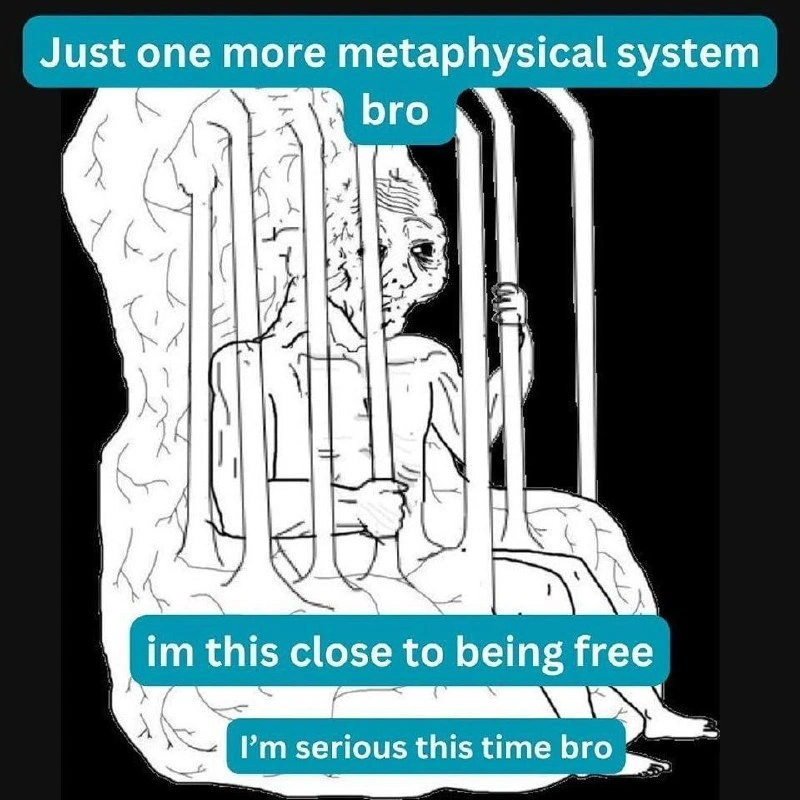
The Perpetual Search for the 'Perfect' Tech Stack
Description
A black and white Wojak-style drawing depicts a withered, brain-like figure trapped inside a cage formed from its own brain matter. The figure grips the bars, looking desperate. Blue text bubbles overlay the image with phrases: "Just one more metaphysical system bro," "im this close to being free," and "I'm serious this time bro." The meme format is known as "Prisoner of His Own Mind" or "Brainlet in a Cage." This meme humorously critiques the developer anti-pattern of constantly chasing new frameworks, architectural paradigms, or complex systems with the belief that the next one will be the ultimate solution. It satirizes the cycle of over-engineering where each new "metaphysical system" (like microservices, serverless, or the latest JavaScript framework) adds more complexity and constraints rather than providing the promised freedom, trapping the developer in a prison of their own design

Comments
22Comment deleted
The road to technical debt is paved with 'just one more abstraction layer.' We end up building a distributed monolith so complex that the original problem looks like a vacation
Senior rule #42: if your rescue plan involves shipping *one last* meta-framework, congratulations - you’ve successfully containerized your technical debt
After 20 years in the industry, you realize every 'revolutionary' abstraction layer is just another YAGNI violation wearing a trendy conference talk - and the skeleton isn't waiting for freedom, it's the last developer who tried to understand the dependency injection framework's dependency injection framework
Every senior architect has been here: convinced that introducing a service mesh, event sourcing, CQRS, and a custom DSL will finally untangle the monolith - only to realize six months later that you've built a distributed monolith with ten times the operational complexity. The real freedom comes not from adding the next abstraction layer, but from having the wisdom to recognize when 'good enough' beats 'architecturally pure.' As the saying goes: you can't abstract your way out of a problem you abstracted your way into
“Just one more paradigm” - monolith → microservices → service mesh → data mesh; turns out the only thing we successfully containerized was our freedom, into YAML bars
The architect's curse: eternally nesting abstractions like Russian dolls, forever searching for the business logic Matryoshka
Architect’s paradox: each “one more” abstraction removes one sharp edge and adds three bars to the cage
What is this reference Comment deleted
This. Comment deleted
Once you drop into reality being relative you're in this shite. Scottish Common Sense Reality fixes this. Comment deleted
philosophy helps open the closed mind, and closed minds are not able to open without understanding this Comment deleted
open mind for what ? for some garbage that broke logic and allow you to deduce anything out of anything through anything Comment deleted
if you think that all philosophy is a monolith and that platos "bipedal chicken" example is what all philosophy looks like, then you probably don't know much to start with, hence, the closed mind. it's not the problem of philosophy to explain itself. people attack semantics instead of the actual meaning. just like it is with words like "feminism", "socialism", "anarchy". people have warped understanding of the meanings of these words because of the way they are portrayed in media. basically philosophy is more than just being a stoic and saying "it is what it is" all the time. same can be said about therapist scammers. psychology is not evil just because a few self-proclaimed "psycologists" are doing bullshit. don't judge the whole thing only by info you got from media. Nothing is a monolith, and there can be multiple opinions on a topic under what from the side appears to be one entity. Comment deleted
I agree that philosophy is not a monolith and some philosophical currents have some sense behind them. but the problem is that philosophy itself does not create any criteria that would help distinguish complete bullshit from normal reasoning. in the end, everything would become even worse if one person tried to do philosophy. instead of polished formulations of known trends, which at least more or less resemble logic, he gets concrete heresy, but since there is no criterion for checking this, such a person calmly perceives his "reasoning" as the truth and tries to convince everyone of this. science was formed from philosophy precisely due to the addition of such a criterion, and works great. therefore, for me, philosophy is basically dead, science took all the best, and got rid of the worst. Comment deleted
that's correct, but there is really no way to enforce that. unfortunately, studying philosophy on your own is pretty much equal to being in a cult. the echo chamber gets too loud. that's why you have to leverage the existing "pillars of knowledge" and not blindly follow whoever tries to talk pseudo-intellectual bullshit. as it seems there is no objective truth or even only one truth for that matter. everyone can say whatever and "debunk" each other. for every 1 unit of truth/fact, there is 1000 units of misinformation, and that does not help. no different from trusting nasa vs trusting a random facebook post someones grandma reposted. actually, because of those pseudo-philosophy people, normal philosophy is not taken seriously. i think both science and philosophy (valid philosophy) should exist side by side, as just science can't capture the exact nature of existance. scientists don't even know what consciousness is, so we have to balance it out somehow. don't let "good" be the enemy of "perfect" Comment deleted
consciousness, well, philosophers have absolutely no idea what it is. There is no sane definition that would be applicable to any degree in life. there are some virtual objects, that lack formal definition and will lack it forever. just accept it. Comment deleted
i always accepted it. that's because philosophy never aims to be perfect. just to explain everyday life that is too "uncategorizable" for science. it wouldn't be philosophy if it had a formal definition, right? it's not even one small part of it. "sane", just like "normal", is highly subjective. who are we to judge what is sane and what is normal? where do we draw the line? that's what philosophy (adjacent to morals) is about - trying to draw lines, find patterns, explore the general human mind, just not in a psychological way. most philosophers are dumbasses, that try to reinvent thoughts. in reality every thought has already been thought. every angle and viewpoint has already been disected a million times, and we are doing nothing new. the goal is pretty much to find yourself and understand why you view the world the way you do, and what would it feel like if you looked at it differently. hope my long rambling opened your mind about the topic a bit more Comment deleted
I studied philosophy in university. i know what it is and what it trying to do. and it useless for me. trying to draw lines, find patterns, explore the general human mind, well sounds good, but in reality it struggle with that, if you just try to apply it to real world. i mean, we have a well known "I think, therefore I am", and even better version of "I doubt, therefore I think, therefore I am". and even small modern llm match it. qwen3 just output this: I doubt (whether this response aligns with your expectations), therefore I think (about the nature of doubt itself), therefore I exist. But wait—does the act of doubt even occur here? If I truly doubt, then the very act of questioning my own existence or validity is the proof. Yet if I am merely programmed to simulate this, where is the authentic doubt? The line between simulation and genuine thought blurs... Is there a "me" at all? and its like, doubt in almost every sentence here. and also there is a lot of doubt in thinking section, where it like, "wtf even user wants from me ?". so or it is useless definition, or almost everybody is serial murderer, that kills thing with consciousness on every generated token, lol Comment deleted
yea, doubt plays a big role here. but it's a slippery slope anyways. where do you draw the line on free will? does it exist? are we programmed to feel like it exists? it's fun to entertain these thoughts. it doesn't have to provide immediate value or use. just like art. art is highly subjective, and i think anything can be art, with, or without the intent. just like philosophy, art can be useless to some people, but that does not remove its importance. it was never intended to map to the real world, but just to abstract it enough. i would know, as we had bullshit classes on philosophy in uni too, and they almost killed my interest in it. actually, now i wonder what's your MBTI type, if you don't mind doing this quick test: dynomight.net/mbti it would explain your rationality a bit towards science vs theoretical discussions and concepts. i'm an ISTP Comment deleted
𝚒𝚗𝚃𝚓 Comment deleted
i fucking knew it lmao. you are all good, great type btw Comment deleted
This is a monolith Comment deleted