
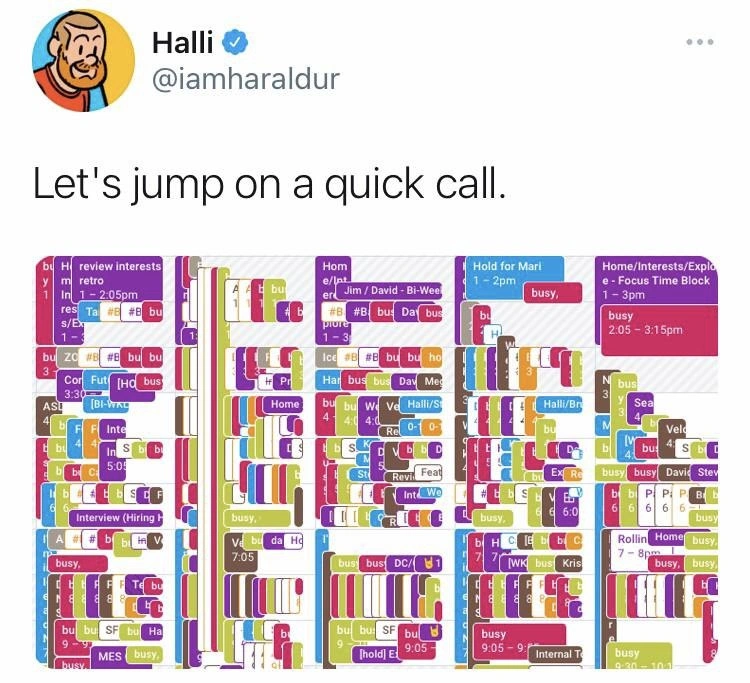
The Absurdity of the 'Quick Call' Request
Description
A meme based on a tweet from Halli (@iamharaldur) that says, 'Let's jump on a quick call.' Below this text is an image of a digital calendar that is completely and chaotically filled with countless overlapping, multi-colored blocks representing meetings and events. The calendar is so fragmented and densely packed that it's impossible to find any free time, visually representing a state of being constantly busy and over-scheduled. The snippets of visible text on the calendar events include 'busy', 'retro', 'Interview', and 'Hold for Mari'. The joke stems from the ironic contrast between the casual, seemingly minor request for a 'quick call' and the visual proof that the person's schedule has no capacity for any interruptions. For experienced developers, this is highly relatable as it highlights the conflict between a meeting-heavy culture and the need for long, uninterrupted blocks of 'deep work' or 'flow state' to be productive in solving complex technical problems


Comments
7Comment deleted
That's not a calendar; it's a real-time visualization of a context-switching memory leak
My calendar already has more fragmentation than our microservices graph - add one more “quick call” and we’re basically introducing a cyclic dependency that blocks prod
After 15 years of optimizing distributed systems for microsecond latencies, I've discovered the true bottleneck in tech isn't network I/O or database locks - it's finding 30 minutes where two engineers' calendars align without triggering a cascade of rescheduled standups, architecture reviews, and that one PM's 'quick sync' that somehow requires three pre-meetings
When someone says 'let's jump on a quick call,' but your calendar looks like a failed game of Tetris where every piece is a meeting and the only line you can't clear is your actual work. This is the senior engineer's version of 'death by a thousand cuts' - except each cut is a 30-minute sync that could have been a Slack message. The real architectural challenge isn't designing distributed systems; it's finding a distributed 15-minute slot across four timezones where everyone isn't already in their seventh 'quick call' of the day
Calendar at 100% utilization, 0% productive throughput - the ultimate anti-pattern for deep work
My calendar is heap fragmentation; a 'quick call' is a stop-the-world GC that relocates focus time and leaks whatever attention was left
At org scale n, meetings grow O(n^2); my calendar is thrashing - your 'quick call' is basically a fork bomb