
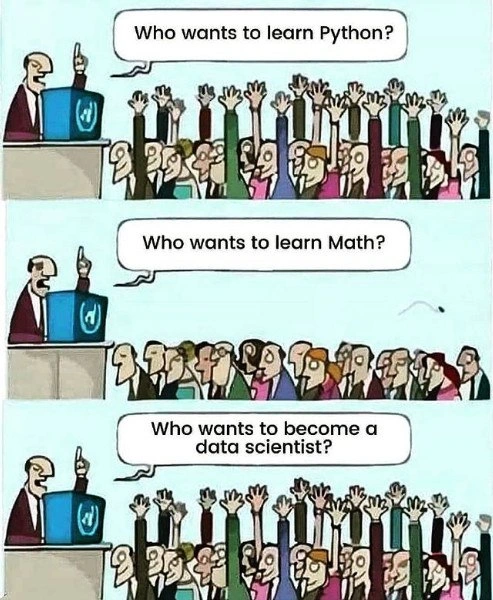
The Data Science hype train skips the math station
Description
A three-panel comic strip depicting a speaker at a podium addressing a large crowd. In the first panel, the speaker asks, 'Who wants to learn Python?'. The entire crowd enthusiastically raises their hands. In the second panel, the speaker asks, 'Who wants to learn Math?'. The crowd falls silent, arms down, with only a single cricket visible in the air, signifying crickets chirping in an empty room. In the final panel, the speaker asks, 'Who wants to become a data scientist?', and the crowd once again raises their hands with enthusiasm. This meme satirizes the disconnect in the tech industry, particularly in the field of data science, where many are drawn to the trendy job title and popular tools like Python but are unwilling to put in the effort to learn the foundational mathematics (statistics, calculus, linear algebra) that are critical for a deep understanding of the subject. It's a commentary on the shallow, hype-driven approach to learning, which senior engineers often observe in less experienced candidates


Comments
10Comment deleted
Many think data science is just `model.fit(X, y)`. The math is what you need when the model fits a little too well on Monday and then spectacularly fails on Tuesday's data
The data-science funnel in three slides: 1) “import pandas as pd” - standing room only, 2) “derive the softmax gradient” - polite coughing in the back, 3) “now ship it to prod on a 128 MB Lambda” - just me, rewriting the whole thing in Go
Everyone wants to be a 'data scientist' until they realize that behind every .fit() and .predict() lies a decade of linear algebra papers, statistical proofs, and the haunting realization that you actually need to understand why gradient descent works, not just import it from sklearn
This perfectly captures the 'I want to be a data scientist but skip the math' phenomenon - like wanting to be a surgeon but refusing to learn anatomy. The reality is that Python is just the scalpel; linear algebra, calculus, and statistics are the years of medical school. You can't just import numpy and expect to understand why your gradient descent is diverging or why your model is overfitting. The math isn't optional; it's literally the science in data science
That lone math hand? It's the principal engineer deriving your gradients while the Python crowd ships 'vibes-based' models
Everyone wants scikit-learn until you say “assume IID,” and suddenly the only thing converging is the attendance
Everyone wants the data-scientist badge - until math is declared a hard runtime dependency and you ask for a derivation of cross-entropy from maximum likelihood
this is the fourth time I'm seeing this on telegram, and it's not getting funnier. Comment deleted
maybe fifth time will be funnier) Comment deleted
When you make memes while you are stressed you'll start loosing your memory Comment deleted