
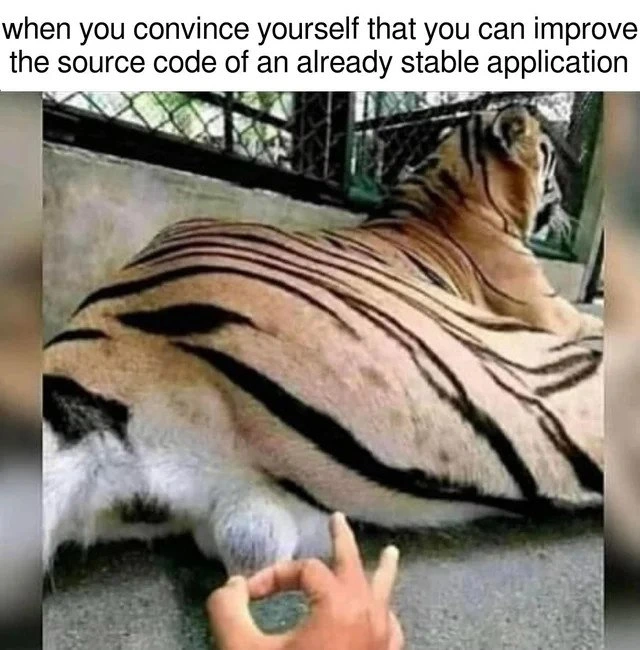
The Perilous Art of Refactoring a Stable Application
Description
This meme humorously illustrates the risks of modifying a system that is already working reliably. The image is split into two parts: a caption at the top and a photograph below. The caption reads, 'when you convince yourself that you can improve the source code of an already stable application'. The photo depicts a person's hand making a playful 'OK' gesture inches away from the rear of a massive, sleeping tiger that is lying in an enclosure. The visual gag is potent: the developer's confidence and desire to 'improve' the code is analogous to this incredibly risky and foolish act of taunting a dangerous predator. For experienced engineers, this is a deeply relatable scenario. It represents the hubris of thinking a 'quick improvement' or a 'simple refactor' on a critical, legacy, or complex but stable system won't have disastrous, unforeseen consequences. The sleeping tiger is the fragile stability of the application, and the poke is the seemingly innocuous code change that could awaken a beast of production incidents, cascading failures, and late-night debugging sessions
Comments
9Comment deleted
That 'stable' application is just a tiger that has memorized the exact shape of all its bugs. Your 'improvement' is just teaching it new, more exciting ways to maul you in production
“It’s just a tiny refactor,” I whisper, pressing merge - basically the software equivalent of flashing an OK sign at a sleeping tiger and wagering my on-call shift on tail latency
After 15 years in this industry, I've learned that the urge to refactor stable production code is like petting a tiger's belly - it looks soft and inviting, but you're one swipe away from explaining to the CTO why the payment gateway that processed $10M yesterday is now returning null pointer exceptions
Ah yes, the classic 'I can refactor this legacy monolith in a weekend' delusion. That codebase has been in production for 15 years, survived three acquisitions, and somehow processes $10M in transactions daily despite violating every SOLID principle known to humanity. But sure, your fresh eyes and that Martin Fowler book you skimmed will definitely improve upon the battle-tested spaghetti that's been keeping the lights on since the Bush administration. Spoiler: You'll spend Monday morning reverting commits and Tuesday explaining to the CTO why the payment gateway is down
Refactoring stable code: the OK gesture of 'it'll be fine,' until the tiger's 'side effects' claw your on-call rotation
Stable code is a tiger held together by undocumented invariants; that “little cleanup” gesture optimizes MTTA while expanding the blast radius
Refactoring a cash‑cow service for a hypothetical 2% speedup is the engineering equivalent of tweaking a tiger’s whiskers - if the tests don’t catch it, the pager will
Dragon BallZ. Comment deleted
fdupes is stable but jdupes improved on it Comment deleted