
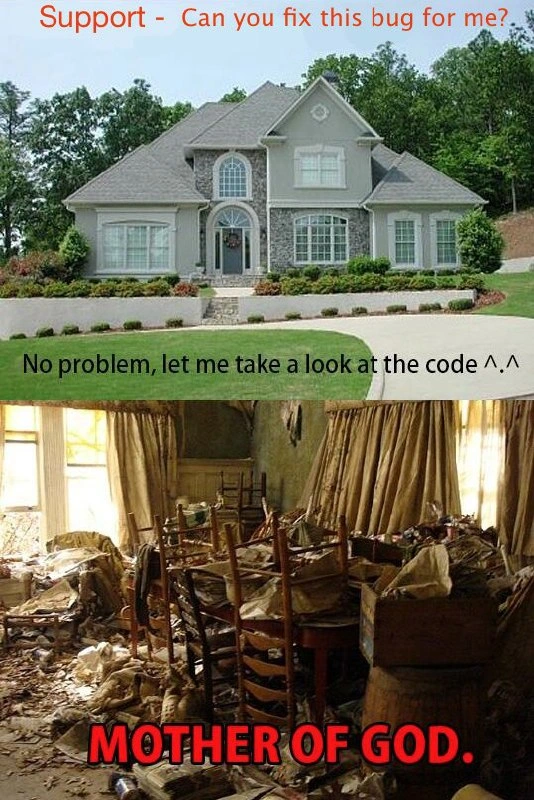
The Discrepancy Between a Clean UI and a Messy Codebase
Description
A two-panel meme that visually contrasts the external appearance of a software application with its internal code structure. The top panel shows a large, beautiful, well-maintained house, representing the clean and polished user interface. Above it, red text reads: 'Support - Can you fix this bug for me?'. Just below the house, green text shows a developer's confident reply: 'No problem, let me take a look at the code ^.^'. The bottom panel presents a starkly different scene: the interior of a house in complete disarray, with overturned furniture, rubble, and general chaos, symbolizing a messy, unmaintained, and complex codebase. At the very bottom, the phrase 'MOTHER OF GOD.' is written in large, bold red letters, capturing the developer's shock and horror upon discovering the state of the underlying code. The meme is a classic illustration of technical debt and the common developer experience where a seemingly minor bug report leads to the discovery of a nightmarish legacy system


Comments
7Comment deleted
The UI is the Zillow listing; the codebase is the termite-infested foundation and leaky plumbing you only discover during the inspection
Turns out the bug lives in a React-wrapped COBOL-PHP monolith - basically a microservice if you squint hard enough and ignore the screaming GC logs
The git history shows one commit from 2009 titled "initial commit" with 47,000 files changed, and the README just says "Dave knows how it works."
Every senior engineer knows this moment: you confidently open a 'simple bug fix' in a legacy system, only to discover the codebase is held together by global variables, circular dependencies, and the tears of developers past. The pristine API documentation promised a well-architected system, but inside it's 50,000 lines of uncommented spaghetti code where changing a single boolean could trigger a cascade failure across three microservices that aren't actually micro. The real kicker? The original architect left five years ago, the last person who understood this module retired, and the only documentation is a README that says 'Good luck.' At this point, you're not fixing a bug - you're performing software archaeology in a codebase that violates every SOLID principle simultaneously while somehow still passing in production. Time to update that Jira ticket from 'Story Points: 2' to 'Story Points: ∞' and schedule a team meeting about 'strategic refactoring initiatives.'
Support's 'quick bug' is client's mansion facade; inside, it's 15 years of unchecked merges and zero-refactor commits
Support called it a tiny bug; opening the repo revealed a 300k-line monolith where the service locator mutates global singletons and feature flags are comments - ETA updated to “after the strangler‑fig migration.”
Opened the “quick bug” and found a 6k‑line GodObject wired with global state and a home‑rolled ORM; at this point, debugging is just structural engineering