
The Stakeholder's Paradox: A Classic Boolean Trap
Description
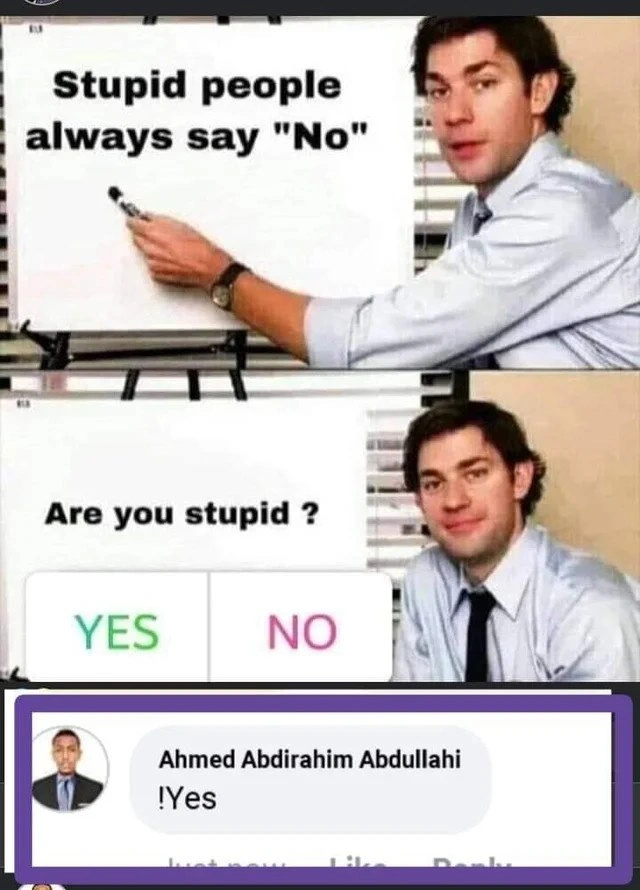
A three-part meme that presents a logical paradox. The first panel uses the 'Jim Halpert pointing at a whiteboard' format from the TV show 'The Office.' The whiteboard reads, 'Stupid people always say "No"'. The second panel shows a poll-style question, 'Are you stupid?', with 'YES' and 'NO' as options. Jim is pictured again, looking smugly at the camera, highlighting the trap: if you say 'No' to prove you aren't stupid, you confirm the initial premise. The third panel at the bottom shows a screenshot of a social media comment from a user named Ahmed Abdirahim Abdullahi, who enthusiastically responds, '!Yes'. While likely intended as an emphatic 'Yes', the exclamation point in front is a common programming operator for 'NOT'. This meme is relatable to senior developers who often deal with paradoxical or poorly defined requirements from stakeholders. It mirrors frustrating logical loops in code or business logic where any choice leads to a problematic outcome, and the only winning move is to defy the premise of the question, much like the final commenter does

Comments
14Comment deleted
This is the classic stakeholder requirement: 'The system must be secure, but also allow passwordless login for executives.' The only valid response is to throw a `NotImplementedException`
Your two-button poll isn’t a binary choice; it’s a case study in why enum columns need CHECK constraints - because somewhere out there, Ahmed is typing “!Yes” and turning your data warehouse into Schrödinger’s boolean
When you've been debugging production for 12 hours straight and someone asks if you've tried the NOT operator on your sanity check - sometimes the only winning move is to throw an unexpected token exception
This is essentially a real-world implementation of the halting problem: you can't write a function that correctly determines if it will return true or false based on its own output. The commenter's '!Yes' response is like adding a negation operator to escape the boolean trap - a classic developer move when faced with a poorly designed API that only accepts true/false but you need to return 'maybe' or throw an exception
Asked “Are you stupid?”, the staff engineer answers “!yes” and opens a PR: ban negative booleans; rename disableNoStupid=false to enableSmart=true
PM ships a Yes/No modal wired to isNotStupid; analytics logs answer = !click.no, and the exec dashboard celebrates 0% stupidity until someone notices the double negation in the ETL
Stakeholders rejecting microservices migration: always 'No' - self-selecting into the monolith maintenance tax bracket
-(yes) Comment deleted
Yesn't Comment deleted
only retarded people think they are smart Comment deleted
But not all of them. Comment deleted
Stupid people can answer with one word only🌚 Comment deleted
One word? But about which amount of bits we are talking here? Comment deleted
!yes Comment deleted