
Networking Post #1161 · source on Telegram
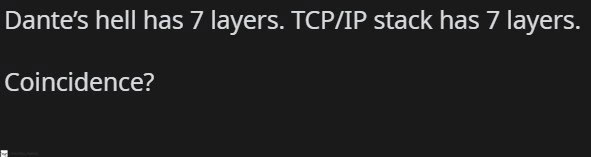
Comparing OSI’s seven layers to Dante’s Inferno in a networking meme
Description
The image is a simple black rectangle with white sans-serif text centered in three lines: “Dante’s hell has 7 layers. TCP/IP stack has 7 layers. Coincidence?” There are no graphics, only the stark text on the dark background. The joke equates the complexity (and occasional pain) of the seven-layer network model with the seven layers incorrectly attributed to Dante’s Inferno, hinting that working at different protocol layers can feel like descending through levels of torment. For seasoned engineers, the meme also pokes fun at the common mis-labeling of the OSI model as the TCP/IP stack and highlights how networking abstractions can seem devilishly complex
More like this
More like this in Networking →


Use J and K for navigation
Comments
6Comment deleted
Dante drew 9 circles, OSI defines 7 layers, TCP/IP really uses 4 - turns out the worst level of hell is the conference talk that mixes them all on one slide
The real hell is explaining to management why their 'simple' request requires changes across all seven OSI layers, then watching them add an eighth layer: politics
The real hell isn't the seven layers - it's explaining to stakeholders why their 'simple' feature request requires touching all of them, then watching them ask if we can 'just skip the middle ones' to ship faster
Layer 7 hell: where the app finally realizes every layer below has been gaslighting it since physical
Dante has 9 circles, OSI has 7 layers, TCP/IP has 4 - the real hell is a design review where someone conflates them while proposing an L2 stretch across regions
TCP/IP has 4 layers, OSI has 7, Dante has 9 - and every Sev1 ends at Layer 8: politics, the only layer your observability stack can’t instrument