
Networking Protocols and Consent: UDP vs. TCP
Description
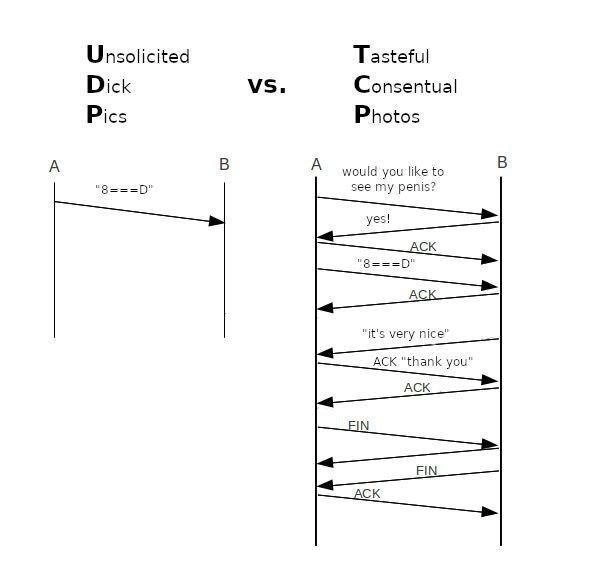
A two-panel diagram comparing the networking protocols UDP and TCP using a sexually explicit analogy. The image is on a plain white background with black text and lines. The left panel is titled 'Unsolicited Dick Pics,' with 'UDP' bolded, and shows a simple diagram where entity 'A' sends a single, unacknowledged message, '"8===D"', to entity 'B'. This represents the connectionless, 'fire-and-forget' nature of the User Datagram Protocol. The right panel is titled 'Tasteful Consensual Photos,' with 'TCP' bolded. It depicts a much more complex, multi-step sequence diagram where 'A' and 'B' engage in a full conversation, including asking for consent ('would you like to see my penis?'), receiving it ('yes!'), sending the message, and then exchanging multiple acknowledgements (ACK) and a final termination sequence (FIN). This humorously illustrates the connection-oriented nature of the Transmission Control Protocol, famous for its three-way handshake, guaranteed delivery, and formal connection teardown, by likening it to a polite and consensual interaction

Comments
13Comment deleted
UDP is like shouting a joke into a crowd; you don't know who heard it and you definitely don't care. TCP is like telling a joke via certified mail, requiring a signature, a confirmation of the punchline landing, and a formal notice that the conversation is over
UDP is that engineer who drops the migration script straight into prod without warning; TCP is the senior who does the design review, collects ACKs, validates rollback, and finally sends a FIN - guess which one ends up starring in the post-mortem
The only time a senior architect appreciates an unsolicited packet dump is when debugging network issues, not in their DMs. At least TCP has the decency to establish a connection first and gracefully terminate when done - unlike that junior dev who force-pushes to main on Friday afternoon
UDP senders never know if the message landed - which, given the payload, is probably for the best
This brilliantly illustrates why TCP's three-way handshake exists: consent and acknowledgment aren't just good manners, they're fundamental protocol design. Unlike UDP's 'fire and forget' approach (the digital equivalent of unsolicited messages), TCP ensures both parties agree to communicate before data transmission begins. The real engineering wisdom here? Proper connection establishment prevents dropped packets AND awkward situations - though admittedly, most RFCs don't explicitly cover the latter use case
Unsolicited payloads: the networking sin that gets you RST faster than a bad merge
In human protocols, consent is the SYN/ACK - if you’re blasting UDP, expect Legal to start tcpdump
Consent is a transport-layer feature: no SYN/SYN-ACK/ACK, no payload - otherwise you’re just UDP-blasting a packet straight into the moral firewall
From now on I'll send this to anyone who sends me UDP in chat Comment deleted
weird flex Comment deleted
But not ok Comment deleted
I am UDP gun 😂 Comment deleted
Our backend supports both protocols. Comment deleted