
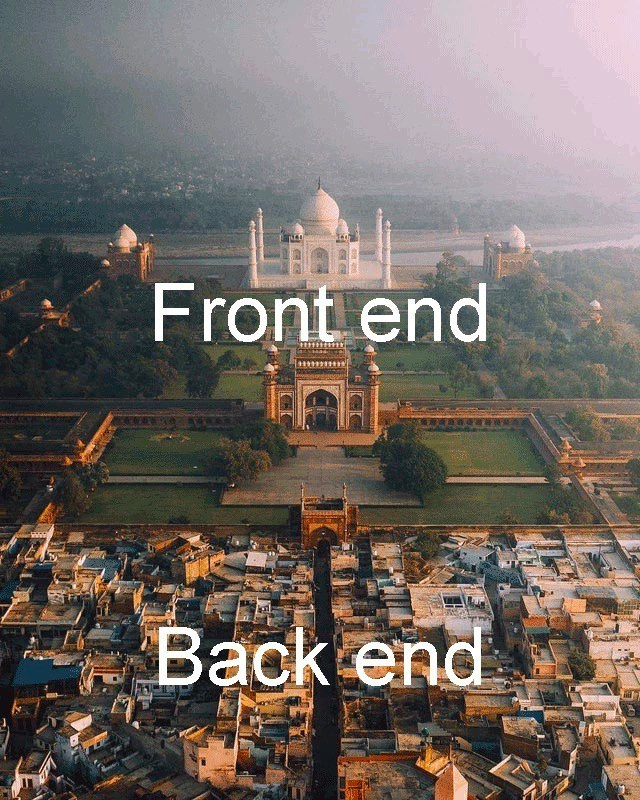
Frontend polish vs backend chaos: the Taj Mahal meme analogy
Description
Aerial photograph of the Taj Mahal complex divided horizontally into two contrasting halves. The upper portion shows the pristine white marble Taj Mahal and manicured green gardens, overlaid with large white text that reads "Front end" - symbolizing the elegant user interface developers obsess over. The lower half depicts the dense, chaotic sprawl of surrounding city rooftops, overlaid with the white text "Back end" - a humorous nod to the often messy server-side code and infrastructure that users never see. The meme leverages visual contrast to poke fun at how teams sometimes invest heavily in UI aesthetics while the underlying backend remains tangled, resonating with engineers who wrestle with architectural imbalance between client and server layers



Comments
6Comment deleted
Every time the user taps that immaculate React button, a saga ping-pongs through 18 “bounded” microservices that all end up writing to the same monolithic Oracle schema - architecturally we call it the Taj-Micro-hell pattern
The frontend is a monument to separation of concerns, while the backend is 47 microservices sharing a single MongoDB instance because "we'll fix it in the next sprint."
The Taj Mahal of web development: everyone photographs the frontend, but the real engineering marvel is the backend foundation that's been handling load for centuries - complete with its own caching layer (the reflecting pool), redundant infrastructure, and a sprawling microservices architecture in the city below that nobody wants to refactor
Frontend: 22 years of Mughal perfection. Backend: Eternal tech debt, load-bearing but one refactor from collapse
Looks like a postcard until you step past the API gateway: 18 microservices, two ORMs, a CDC pipeline, and a stored-proc dynasty held together by eventual consistency and wishful indexing
Front end: pixel-perfect SPA; back end: a distributed monolith held together by 'realtime' cron jobs and an ORM that treats N+1 as a design pattern