
How to Heat Your Room with Two Lines of Swift
Description
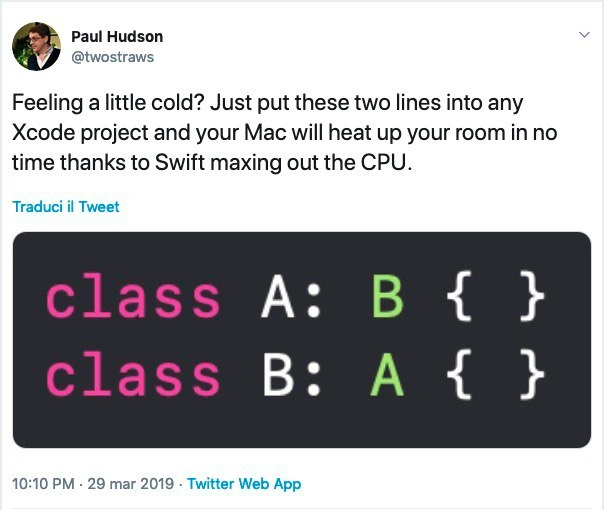
This image is a screenshot of a tweet from Paul Hudson (@twostraws), a prominent figure in the Swift developer community. The tweet humorously suggests a solution for being cold: "Feeling a little cold? Just put these two lines into any Xcode project and your Mac will heat up your room in no time thanks to Swift maxing out the CPU." Below this text is a syntax-highlighted image of two lines of Swift code: `class A: B { }` and `class B: A { }`. The technical joke here is the creation of a circular dependency, also known as circular inheritance. Class A is defined to inherit from Class B, while Class B is simultaneously defined to inherit from Class A. When the Swift compiler attempts to process this, it gets caught in an infinite loop, as it cannot determine the memory layout of either class without first knowing the other. This recursive nightmare causes the compiler process to consume 100% of a CPU core, leading to the computer's processor working intensely and generating a significant amount of heat. For developers, particularly those in the Apple ecosystem, it's a clever and relatable joke about compiler-crashing code patterns presented as a funny, if impractical, life hack


Comments
8Comment deleted
Senior devs don't need a linter to find circular dependencies; they can just listen for the sound of the CI runner's fans preparing for takeoff
Tarjan said cycle detection is linear - Swift saw class A : B, class B : A and converted O(N) into BTUs, instantly provisioning the office’s new space heater
The Swift compiler's type checker running in O(∞) time is still more efficient than our sprint planning meetings trying to resolve circular dependencies between teams
Cyclic dependency: rejected in code review, embraced by facilities management as a Q4 heating cost optimization
Ah yes, the classic 'free heating solution' for developers - circular inheritance in Swift. Two lines of code that transform your MacBook Pro into a space heater by sending the type checker into an existential crisis. It's the compiler equivalent of 'which came first, the chicken or the egg?' - except instead of philosophical debate, you get thermal throttling and fan noise that sounds like a jet engine. Swift's type system is so eager to prove correctness that it'll happily burn through CPU cycles until the heat death of the universe (or your next forced reboot). At least with C++ template metaprogramming errors, you get a novel-length error message to read while you wait; Swift just silently cooks your laptop. Pro tip: This also works great for stress-testing your cooling system and validating that AppleCare purchase
Swift's type checker: achieving perfect CPU utilization by refusing to resolve what mortals call 'cycles'
Mutual inheritance is the design pattern where the compiler tries to topologically sort a cycle, your fans achieve quorum, and your Mac implements Proof-of-Heat
Circular inheritance in Swift is the only design pattern with a BTU rating - add class A: B and class B: A, and Xcode’s type checker debates lineage until your MacBook becomes a space heater