
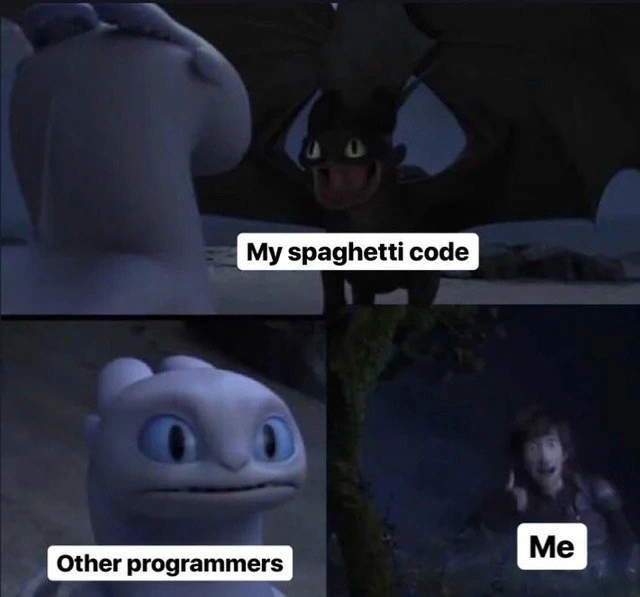
My Spaghetti Code: A Masterpiece to Me, a Horror to Others
Description
This is a four-panel meme using the 'Toothless Presents Himself' format from the movie 'How to Train Your Dragon: The Hidden World.' In the top-left and top-right panels, the black dragon Toothless, labeled 'My spaghetti code,' is performing an awkward, goofy courtship dance for the white Light Fury dragon. In the bottom-left panel, the Light Fury, labeled 'Other programmers,' stares back with a look of utter confusion and disdain. In the bottom-right panel, the character Hiccup, labeled 'Me,' is hiding behind a tree, enthusiastically and encouragingly gesturing for Toothless to continue. The meme perfectly captures the dynamic of a code review for a piece of poorly written, tangled ('spaghetti') code. The author ('Me') sees their creation as functional and clever, proudly presenting it. However, their peers ('Other programmers') who must read, understand, and maintain it are horrified by its complexity and lack of structure, seeing it as the monster it truly is
Comments
7Comment deleted
I once showed my team a function I wrote that had seven nested loops and a dozen global variables. I called it 'The Engine.' They renamed it 'The Unspeakable Horror' and now we only refer to it in hushed tones during retrospectives
I call it architectural archaeology: when the team unearths my 2 000-line Perl script secretly powering the “stateless” microservice, I just tag it “vendor code - DO NOT TOUCH” and fade behind the Kanban board
The real architectural pattern here is the Observer pattern - where everyone observes your code is terrible, but you're implementing the Singleton pattern of being the only one who thinks it's fine because 'it works on my machine' and you understand the business context from 2018
Every senior engineer has been there: you inherit a codebase where the control flow looks like someone implemented goto statements in a language that doesn't support them, the dependency graph forms a perfect circle, and the only documentation is a comment that says 'TODO: refactor this mess.' You present it in the architecture review, and the room goes silent - not the contemplative kind, but the 'we're all mentally calculating the rewrite estimate' kind. The real kicker? It's in production, it's making money, and nobody wants to be the one to touch it. Welcome to the spaghetti code support group, where we're all just one merge conflict away from tears
My spaghetti code is one giant strongly connected component; everyone else freezes while I run before someone labels me both the SPOF and the runbook
I call it “exception‑driven control plane with temporal coupling”; reviewers call it “Big Ball of Mud,” then quietly declare a merge freeze
That rare code review where the author nods along with the 'rewrite it' verdict