
A Tale of Two Terminators: Windows vs. Unix Signal Handling
Description
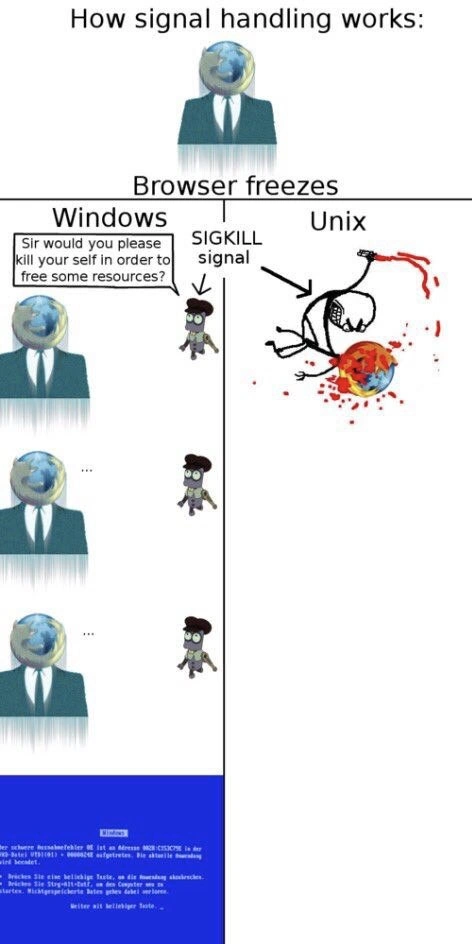
A vertically-oriented, multi-panel comic titled 'How signal handling works:' that compares the process termination philosophies of Windows and Unix when a browser freezes. The top panel shows a character with a globe for a head in a suit, representing a frozen browser process. The comic then splits into two columns. On the left, under 'Windows', a system process politely asks the browser, 'Sir would you please kill your self in order to free some resources?'. The browser process remains unresponsive through several panels, culminating in a Blue Screen of Death (BSOD) with German text. On the right, under 'Unix', the system process sends a 'SIGKILL signal'. This is depicted by a stick figure brutally and graphically killing the globe-headed process, which is lying in a pool of blood. The humor is aimed at experienced developers and system administrators, contrasting Windows' cooperative, message-based approach to closing applications (which can fail if the app is unresponsive) with the Unix/Linux kernel's absolute power to terminate any process immediately and forcefully with the SIGKILL (kill -9) signal, an unblockable command ensuring the process is stopped



Comments
7Comment deleted
Windows sends WM_CLOSE, which is like asking a toddler to please stop screaming. SIGKILL is the kernel yeeting that toddler directly into the sun
Windows politely sends WM_CLOSE hoping the browser does a clean COM teardown; Unix just fires kill -9 - because sometimes the fastest garbage collector is a coroner
The real difference between Windows and Unix: Windows asks your process to consider therapy before termination, while Unix just sends a hitman named SIGKILL who doesn't negotiate. At least Windows gives you a beautiful blue farewell screen in multiple languages - because even kernel panics deserve internationalization
The fundamental difference between Windows and Unix process management: Windows sends a strongly-worded letter requesting voluntary termination, while Unix just sends SIGKILL - the one signal that doesn't take 'no' for an answer. It's the difference between 'Would you kindly exit?' and 'kill -9' - because sometimes being polite just means your browser gets to keep eating RAM for another five minutes while you wait for it to 'think about' closing
Unix: SIGKILL - non-maskable, non-negotiable. Windows: End Task - posts WM_CLOSE to a dead message pump and waits for the reply until the kernel files the BSOD paperwork
Windows: 'Pretty please kill yourself.' Unix: SIGKILL - because in kernel space, due process is for suckers
Unix: kill -9 and the kernel quietly reclaims the heap; Windows: WM_CLOSE → three dots → TerminateProcess → BugCheck - aka performing garbage collection at the datacenter level