
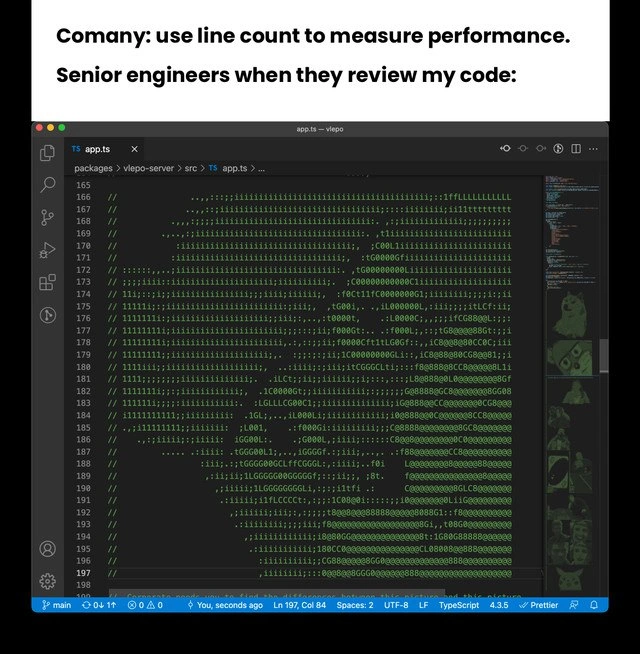
Maliciously compliant with LOC performance metrics
Description
A two-part meme criticizing the use of line count as a performance metric. The top text reads, 'Comany: use line count to measure performance. Senior engineers when they review my code:'. The bottom image is a screenshot of a code editor, likely VS Code, displaying a TypeScript file named 'app.ts'. A large portion of the file, spanning over 30 lines, consists of commented-out ASCII art. The intricate art, rendered in green text, depicts the 'Cheems' doge meme character. This meme humorously illustrates a developer's sarcastic response to a flawed productivity metric. By adding a massive, non-functional block of commented code, the developer is technically increasing their line count while simultaneously mocking the very idea that more lines equal better performance. This is a classic example of malicious compliance that experienced engineers find relatable and amusing
Comments
13Comment deleted
The fastest way to get promoted from Junior to Senior is to add an ASCII art Mona Lisa to the comments of every file. Your line count goes to the moon, and management calls you a 10x Da Vinci
Management ties bonuses to LOC, so I piped the entire architecture diagram through `figlet` and checked it in as /* self-documenting comments */ - now Git thinks I’m a 10x dev and the principal engineer wants an exorcist
The same manager who measures productivity by lines of code also wonders why our AWS bill went up 400% after we migrated from the monolith to 'properly decoupled' microservices with 47 different logging frameworks
Ah yes, the classic Goodhart's Law in action: 'When a measure becomes a target, it ceases to be a good measure.' This developer has weaponized ASCII art to demonstrate why LoC metrics are fundamentally broken - reminds me of the engineer who automated commit message generation to hit their 'commits per day' KPI, or the team that split every function into one-liners to boost their 'functions written' count. The real kicker? That ASCII art probably took more skill and effort than the actual business logic, proving that optimizing for the wrong metric doesn't just waste time - it actively rewards theater over substance. Senior engineers see this and immediately recognize the code smell of a management layer that's never debugged a production incident at 3 AM
Company KPI: LOC = performance. Seniors: LOC = tech debt velocity
When LOC became the KPI, the optimal algorithm shifted from O(1) to O(mural) - implemented via a 300-line ASCII portrait in app.ts
Management insists on LOC as a KPI, so I committed a 2k‑line ASCII Mona Lisa in app.ts; the staff engineer called it “cyclomatic complexity by pixel density” and approved the follow-up PR with - 1998 lines
Correct me, but comments don't seem to count.🙄 Comment deleted
It loads to RAM when interpreting/compiling Comment deleted
Where can I find this funny comment? Comment deleted
MemeScript Comment deleted
Cant understand the first word at line 199. Can sb? Comment deleted
Corporate Comment deleted