
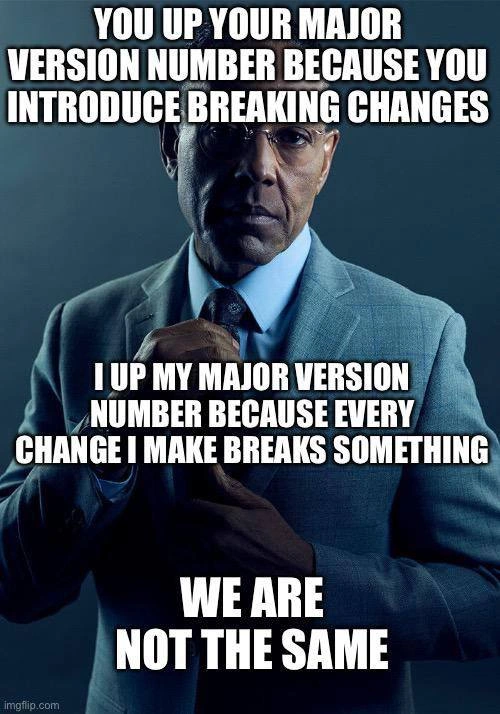
Semantic Versioning Ideal vs. Fragile Codebase Reality
Description
This is a 'We Are Not the Same' meme, featuring a half-body shot of actor Giancarlo Esposito in his role as the character Gus Fring. He is wearing a grey suit and adjusting his tie, looking directly at the viewer with a calm but intimidating expression. The background is a dark, moody grey. White, all-caps text is overlaid on the image in three parts. Top text: 'YOU UP YOUR MAJOR VERSION NUMBER BECAUSE YOU INTRODUCE BREAKING CHANGES'. Middle text: 'I UP MY MAJOR VERSION NUMBER BECAUSE EVERY CHANGE I MAKE BREAKS SOMETHING'. Bottom text: 'WE ARE NOT THE SAME'. The humor contrasts the formal, correct practice of Semantic Versioning (SemVer), where a major version increment signals intentional, incompatible API changes, with the chaotic reality of working on a brittle, poorly-architected system. In the latter case, any modification, no matter how small, causes unintentional breaking changes, forcing a major version bump not as a sign of planned evolution, but as an admission of code fragility and high technical debt. It's a cynical joke relatable to any senior developer who has maintained a legacy system where every bug fix is a gamble
Comments
18Comment deleted
The first team follows SemVer. The second team follows 'OhGodWhatBrokeNowVer'
My package is on v73.0.0 and still marked “beta” - turns out we invented quantum semver: every release is simultaneously stable and broken until someone observes it in prod
The difference between a junior and senior developer isn't that seniors write better code - it's that seniors have learned to preemptively bump the major version because they know their 'minor refactor' will somehow break that one integration test written in 2016 that nobody understands but everyone's afraid to delete
The real semantic versioning debate: Some architects carefully orchestrate major version bumps after months of deprecation warnings and migration guides, while others treat version numbers like a high score in 'how many prod incidents can one commit cause.' Both reach v47.0.0, but only one knows why they're there - the other just knows their CI/CD pipeline has trust issues and their users have Stockholm syndrome
You architect breaking changes; I just refactor one module and watch the monolith unravel like a poorly managed Kubernetes cluster
Our semver policy is simple: every merge increments the leftmost digit - incident count is monotonic, so our versioning is too
SemVer says major = breaking changes; in our distributed monolith that’s basically major-per-commit - we just call it Continuous Incompatibility
Also thats a binary tree* Comment deleted
I up version number because cicd fails otherwise Comment deleted
Why don't you just simply use: current modified modified1 modified2 new neww newww latest latest2 2024.10.07 2024.10.11 2024.10.11.2 🙄🤌 Comment deleted
last final realfinal Comment deleted
ultimate! Comment deleted
2025.05.05.20.25.05 Comment deleted
Version 252412 Comment deleted
06052025 Comment deleted
best style Comment deleted
05052025-2 Comment deleted
0.0.YYYYMMDDHHmm Comment deleted