
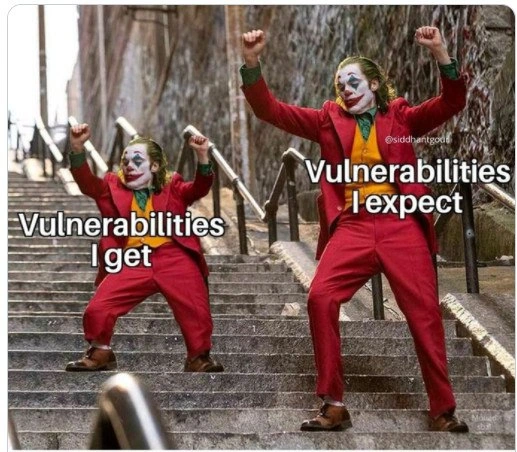
The Grand Vulnerabilities We Expect vs. The Tiny Ones We Get
Description
A meme using a two-figure template of the Joker from the 2019 film dancing on a staircase. On the right, a full-sized Joker dances triumphantly with the text 'Vulnerabilities I expect' overlaid. On the left, a digitally shrunken, miniature version of the same dancing Joker has the text 'Vulnerabilities I get'. The meme humorously contrasts the expectation of discovering significant, critical security flaws with the reality of dealing with a long list of minor, low-impact vulnerabilities often flagged by automated security scanners. For experienced developers and security professionals, this is a deeply relatable scenario. They might anticipate uncovering a major architectural flaw or a zero-day exploit, but instead, their daily work involves triaging numerous low-severity issues, dependency warnings (like those from npm audit), or theoretical vulnerabilities with no practical attack vector
Comments
10Comment deleted
I was hoping to find a critical RCE to justify my salary. Instead, my scanner found a low-risk cross-site scripting vulnerability on a 404 page that's only accessible in IE6. Time for a promotion
That feeling when you pay enterprise-grade pentest rates and the “critical” finding is a SameSite cookie flag - while the public S3 bucket called prod-db-backup is “out of scope.”
After spending months implementing OAuth2, JWT validation, rate limiting, and CSP headers, the actual vulnerability turns out to be an exposed .env file in a public repo from 2019 that nobody remembered existed
Every security audit starts with dreams of finding the next Log4Shell, but ends with 'Missing HttpOnly flag on non-sensitive cookie' and 'Outdated jQuery version with no exploitable path.' The real vulnerability is thinking your codebase is interesting enough for a zero-day
Expect: SSRF→IMDS→RCE to justify the budget; reality: seventy “critical” Dependabot alerts for a dev-only transitive lodash, a missing security.txt, and a DAST false positive - CVSS 9.8, reachable impact 0
Expected: 5 CVEs from deps. Reality: Enough to make Log4Shell look like a proof-of-concept
The vulns I expect: a deserialization RCE chain; the vulns I get: “critical” CVEs in dev-only transitive deps - patching them breaks CI more reliably than any attacker breaks prod
their criticality though... Comment deleted
We live in a society........ Comment deleted
what? Comment deleted