
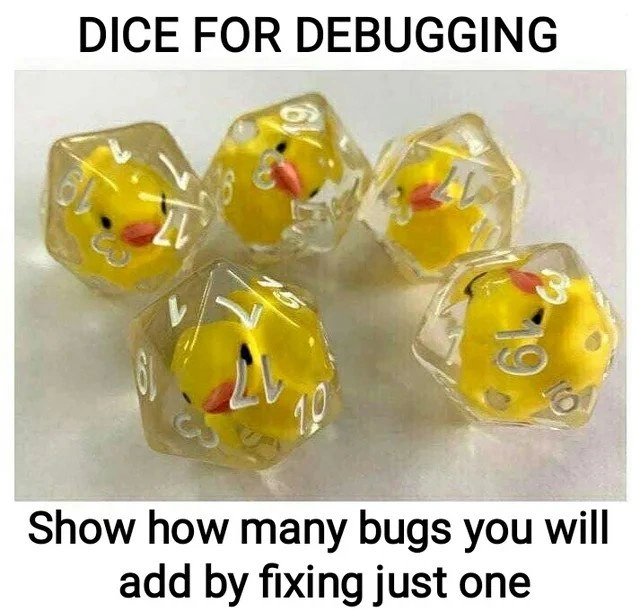
Debugging Dice: Roll for New Bugs
Description
A photograph displays five transparent, 20-sided dice, commonly known as d20s. Inside each die, a small, cute yellow rubber duck is embedded. The image is captioned with bold, black text at the top, reading, 'DICE FOR DEBUGGING,' and at the bottom, 'Show how many bugs you will add by fixing just one.' This meme humorously merges the concept of 'rubber duck debugging' - a method where developers explain their code line-by-line to an inanimate object to find solutions - with the chaotic, unpredictable nature of software development. The use of a d20, a staple in tabletop role-playing games like Dungeons & Dragons, implies that fixing a single bug has a high chance of creating a large, random number of new problems, a frustratingly common experience for seasoned engineers working in complex systems
Comments
17Comment deleted
In our legacy system, we don't use D20s; we use a D100. We call it the 'sprint commitment die'
When the PM requests a confidence interval for the hotfix, I roll the rubber-duck d20 three times - instant Monte Carlo regression forecast
Finally, a way to quantify the exact multiplier for the hydra effect in production - though experienced architects know the real number is always n+1 where n is whatever the dice show, plus an additional critical bug that only appears during the CEO's demo
The dice perfectly capture the Monte Carlo method of debugging: you never quite know the outcome, but you're statistically guaranteed that fixing one edge case will spawn N+1 new ones across different modules. Senior engineers know the real skill isn't preventing this - it's accurately estimating which number the dice will land on during sprint planning
Architecture review replaced by a rubber-duck d20 - the roll equals the regression fan-out; a natural 20 toggles a forgotten feature flag and pages SRE
Rubber-duck d20: roll to size the blast radius of a “one-line fix.” 1 = green build; 20 = transitive dependency bump, three Jira epics, a feature flag, and an outage someone insists is unrelated
The second law of debugging: every fix increases codebase bug entropy, now with authentic D&D randomness
I experienced a similar one: how many new features could be implemented after the first one Comment deleted
You need to roll em all Comment deleted
Each side is a power of ten Comment deleted
2 Comment deleted
Nice Comment deleted
Well now look at this in a paradox way... you cant roll 0 Comment deleted
Ah shit Comment deleted
you have used d6, not d20 Comment deleted
Has anybody? Comment deleted
never experienced something like this, really. always broke things just adding new features to my legacy-code project, but they are fixed too after some time Comment deleted