
Security Post #6840 · source on Telegram
Rickroll Masterclass: Phishing Awareness Training the Developer Community Actually Paid Attention To
Description
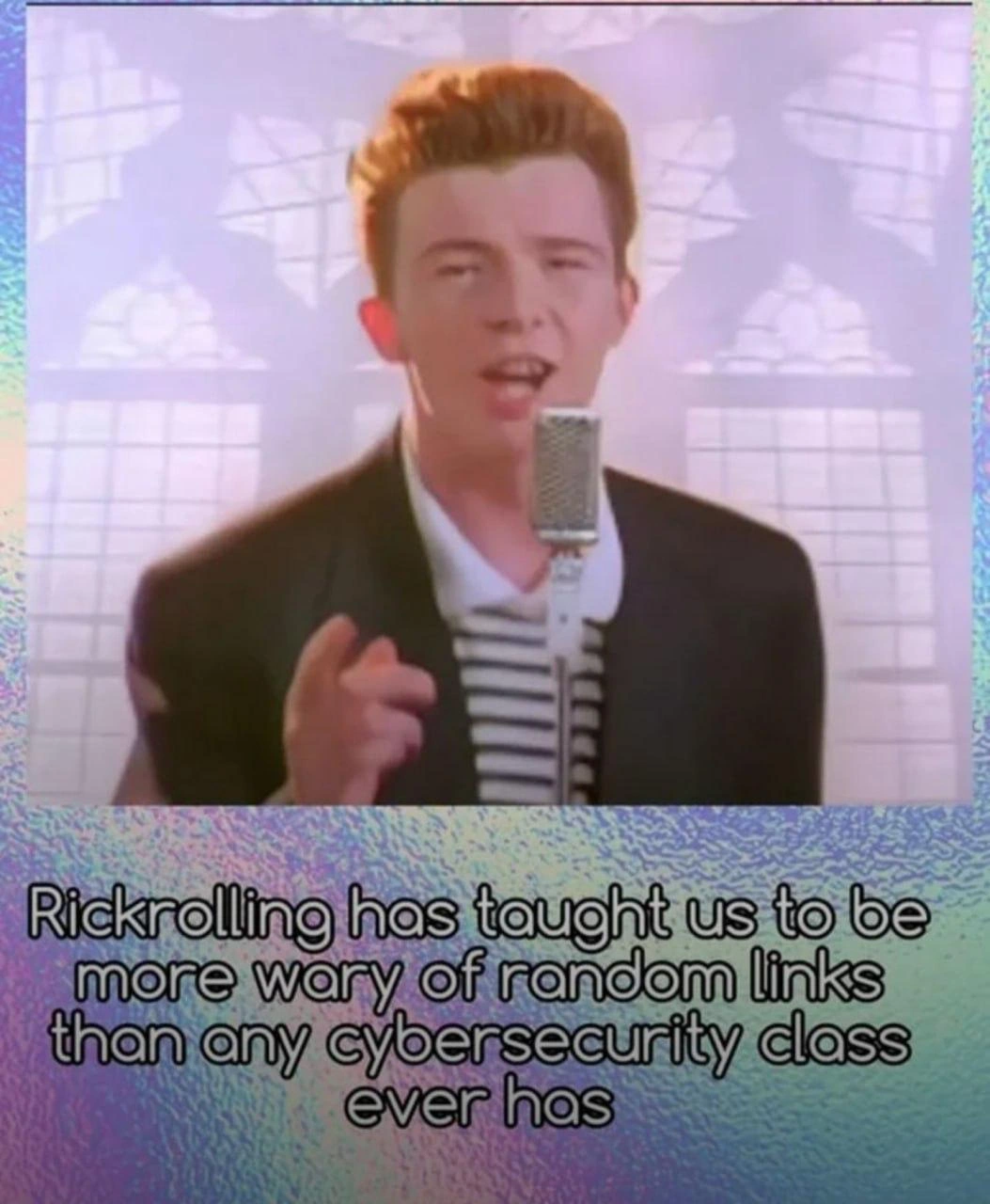
The meme shows a still frame from the famous 1980s music video often used for “rickrolling.” The singer’s face is intentionally blurred for anonymity, but the retro microphone, striped shirt, and back-lit stained-glass windows are clearly visible. Below the image, bold black text on a pastel, oily-iridescent background reads: “Rickrolling has taught us to be more wary of random links than any cybersecurity class ever has.” The visual joke contrasts a light-hearted internet prank with the serious discipline of infosec, highlighting how repeated unexpected YouTube redirects conditioned seasoned engineers to hover-preview every URL long before formal phishing-simulation platforms existed
More like this
More like this in Security →
Use J and K for navigation
Comments
19Comment deleted
If compliance swapped the yearly 45-minute CBT for one disguised Rick Astley link, we’d hit zero-click phishing faster than you can say “never gonna give you up.”
After 15 years in tech, I've seen million-dollar security awareness programs fail where a simple Rick Astley video succeeded - turns out the best penetration testing is when users actually remember to check URLs because they're terrified of hearing that drum intro at full volume during a screen share
Rickrolling inadvertently became the most effective zero-cost security awareness training program in history - teaching an entire generation to hover over links, inspect URLs, and maintain a healthy paranoia about shortened links. No SANS course, no expensive security certification, just Rick Astley's dulcet tones conditioning us to treat every suspicious link like a potential XSS payload. The irony? A 1987 pop song did more for phishing prevention than decades of corporate security training videos. Now every engineer instinctively checks for 'dQw4w9WgXcQ' in YouTube URLs before clicking, a Pavlovian response that's probably prevented more credential theft than two-factor authentication
Rickrolls turned me into a human IDS: hover‑inspect every a[href], URL‑decode the bit.ly chain with curl -I, then maybe click
Rickrolling: the zero-day social engineering exploit that patched more clickbait vulns than a decade of phishing sims
Zero‑trust in our org started the day every “design doc” link resolved to dQw4w9WgXcQ - now we hover to inspect the href and curl -I the redirect chain before clicking
XcQ Comment deleted
Here should be a link with a research that proves this statement Comment deleted
here's a really good study on it: https://arxiv.org/abs/2204.06826 Comment deleted
Telegram spoils it :( Comment deleted
i tried my best 🥲 Comment deleted
you need redirect link Comment deleted
the joke writes itself Comment deleted
oh yeah, I wrote a blog post on that actually: https://riedler.wien/!/Blog/20240328/ Comment deleted
This girl is hot 🥵 Just look! Comment deleted
We're no strangers to love Comment deleted
You know the rules, and so do I Comment deleted
Jokes on you, I actually click every link hoping to get rickrolled because the song is fire Comment deleted
🔥 Comment deleted