
Why we code: it's easier than people
Description
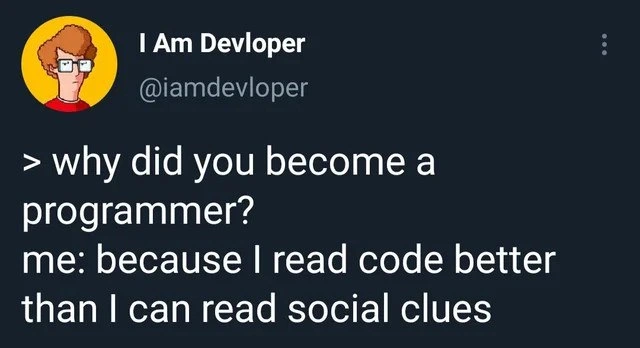
A screenshot of a tweet from the popular developer humor account 'I Am Devloper' (@iamdevloper). The tweet is formatted as a short dialogue. A question is posed: '> why did you become a programmer?'. The response is, 'me: because I read code better than I can read social clues'. The image captures a widely-felt sentiment in the software development community, playing on the stereotype of developers being more comfortable with the logical, predictable world of machines and code than with the ambiguous and often confusing nuances of human social interaction. It’s a self-deprecating and relatable joke for many senior engineers who find solace in the clarity of a well-structured algorithm compared to the 'undocumented API' of social etiquette
Comments
7Comment deleted
Social cues are like an undocumented, legacy API with a 90% error rate and responses that vary based on the time of day. Code is... well, it's also an undocumented legacy API, but at least I can attach a debugger to it
Human conversations are eventually consistent and the last write wins; I picked programming because git at least shows me the merge conflict before I embarrass myself
After 20 years in tech, I've mastered distributed systems, Byzantine fault tolerance, and CAP theorem trade-offs, but I still can't figure out if that Slack emoji reaction means 'good job' or 'please never do this again'
The real reason many of us became developers: we discovered that compilers give you clear, deterministic error messages, while humans respond to 'Hello World' with 'It's complicated.' At least with code, when something doesn't compile, you get a stack trace instead of passive-aggressive silence
Small talk needs an OpenAPI spec and a linter - right now it’s a flaky, undocumented RPC with undefined behavior
Humans are the only API with no schema, no logs, and constant breaking changes - no wonder my parser prefers source code
Code has explicit types; social cues are just Any - runtime errors guaranteed