
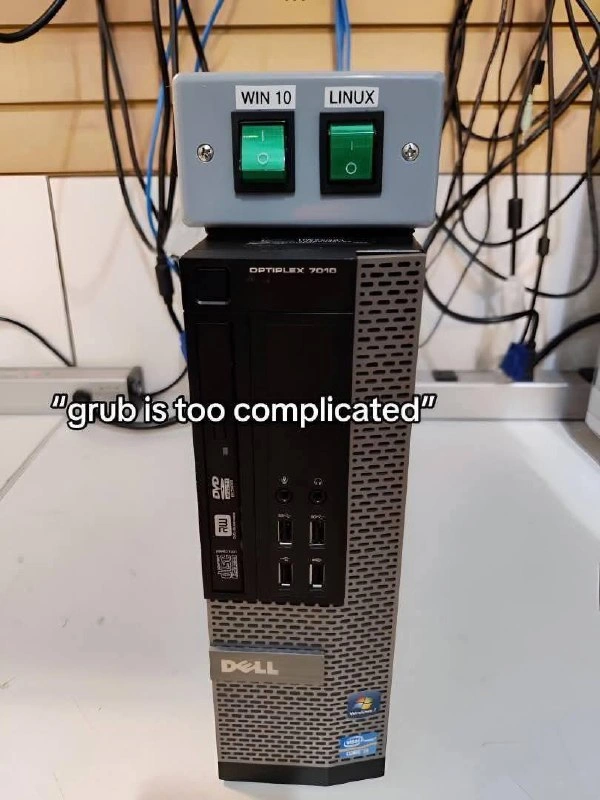
The Hardware Solution to a Software Problem: 'GRUB is too complicated'
Description
A photo of a Dell Optiplex 7010 small form-factor desktop computer sitting on a desk. Mounted on top of the PC is a custom-built gray electrical box with two large, green, illuminated physical toggle switches. One switch is labeled 'WIN 10' and the other 'LINUX'. A text caption in the foreground reads, '"grub is too complicated"'. This meme is a satirical take on the challenges of dual-booting operating systems. Instead of using the standard GRUB software bootloader to choose between Windows and Linux at startup, the user has engineered an elaborate physical switch. The humor lies in the absurdity of building a hardware solution for what is fundamentally a software configuration task, ironically suggesting that dealing with GRUB's complexities - a common frustration for Linux users, especially when Windows updates interfere with it - is more difficult than wiring up a physical device, likely to control power to separate hard drives

Comments
22Comment deleted
This is the only bootloader that's truly resilient to a Windows update. It's not a bug, it's a hardware feature
Why bother memorizing GRUB’s config syntax when you can achieve five-nines boot reliability with a $2 DPDT and a roll of electrical tape?
After 15 years of editing grub.cfg files and recovering from kernel panics caused by botched dual-boot configurations, sometimes the most elegant solution is two $3 switches from the hardware store and a prayer that nobody asks about your disaster recovery plan
When your senior architect says 'we need a more robust boot selection mechanism,' they probably didn't mean literally bypassing GRUB with industrial rocker switches - but honestly, this has better uptime than most bootloader configs after a kernel update. No more 'grub-install' incantations at 2 AM, just flip the switch and pray your BIOS boot order cooperates. The real question: did they wire this to the power supply or are we looking at a sophisticated BIOS boot device selector? Either way, it's more reliable than remembering which F-key enters the boot menu on a Dell
Replaced GRUB with a two‑phase commit on the SATA power rails - finally a bootloader Windows Update can’t overwrite
We replaced GRUB with two hardware feature flags; elegant - until someone creates split-brain by flipping both to 1
GRUB config: 50 lines of regex hell. This? Two switches, zero timeouts
Но ведь можно было сделать один тумблер. А что будет, если оба включить? But it was possible to make one toggle switch. What will happen if both are turned on? Comment deleted
Потеряешь boot раздел безвозвратно You will lose the boot partition irrevocably. Comment deleted
please use english in this chat or provide a translation for your message (use "edit message" feature) (2) Comment deleted
side by side bootload Comment deleted
splitscreen boot Comment deleted
please use english in this chat or provide a translation for your message (use "edit message" feature) Comment deleted
How would this setup work? Comment deleted
All x86 bootloading methods — both MBR/BIOS and GPT/UEFI — are a complete PITA by design, full of "magic": partitions, stage1 code, frozen configs, etc. 🤮 Comment deleted
I'm not sure I get what you mean — you can't support multiboot without partitions, UEFI doesn't need stage1 code (see e.g. efistub), and I'm not sure what "frozen configs" is supposed to mean Comment deleted
UEFI needs a FAT partition (which lack access control). When using GRUB to boot Xen under UEFI Secure Boot, a separate config file is needed for each GRUB menu entry. And, yes, UEFI itself is difficult to implement properly, so most implementations appear to be not fully compliant (requiring you to disable EFI Runtime Services in the payload being booted, for example, which quite defeats the purpose of using UEFI as an advanced alternative to BIOS) and/or insecure. Comment deleted
That sounds like a GRUB problem, no? Not anything inherent to UEFI Comment deleted
How do you propose bootloaders to be found otherwise? The firmware can't just include drivers for each file system, they can only include a select few, which turns out to be FAT in this case. Supplying a driver separately raises all the same security questions about the source of truth. Comment deleted
Like, you need some place to put the bootloader in, and that can't always be your normal filesystem, so I don't see why it can't be FAT Comment deleted
That's at least clearly better than making the file special and risking breaking your system by touching it the wrong way Comment deleted
Missed the opportunity to use one of those buttons that have to activate ends (I don't remember the name of them) Comment deleted