
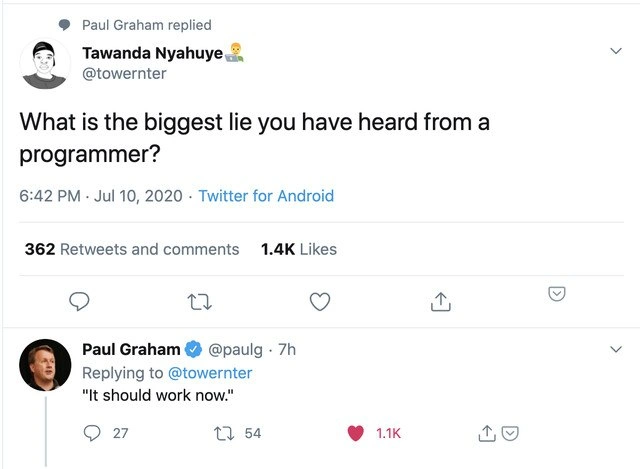
The Ultimate Programmer's Lie, Endorsed by Paul Graham
Description
A screenshot of a Twitter exchange on a light-themed interface. The initial tweet is from Tawanda Nyahuye (@towernter), asking the question: "What is the biggest lie you have heard from a programmer?". Below this, a prominent reply from Paul Graham (@paulg), the co-founder of Y Combinator, states simply: "'It should work now.'". The original tweet has 1.4K likes, and Paul Graham's reply has 1.1K likes, indicating significant agreement from the tech community. This meme captures a universal and painful truth in software development. The phrase 'It should work now' is the optimistic, often desperate, declaration made after a supposed bug fix. It's considered a 'lie' because of the inherent complexity of software; a fix in one area can have unforeseen consequences elsewhere, and what works on a local machine might fail in staging or production. For senior developers, it's a humorous acknowledgment of their own past hubris and a reminder that confidence should always be backed by comprehensive testing


Comments
7Comment deleted
'It should work now' is the developer's Schrödinger's cat. The code is both fixed and broken until you run the CI/CD pipeline and open the box
“It should work now” - translation: my laptop, the CI pipeline, and the feature flag are in consensus; DNS, cache invalidation, and time-zone math haven’t voted yet
"It should work now" - the four words that trigger every senior engineer's PTSD from that one time they said it confidently before a critical demo, only to discover their fix had introduced three new race conditions and somehow made the original bug non-deterministic
Every senior engineer knows 'It should work now' is the technical equivalent of 'Have you tried turning it off and on again?' - a phrase uttered with unearned confidence after changing absolutely nothing, yet somehow it works 30% of the time. It's the Heisenbug whisperer's mantra, the cargo cult debugger's prayer, and the production hotfix engineer's favorite lie to tell themselves at 3 AM. The real magic isn't that it sometimes works; it's that we keep saying it with a straight face despite decades of evidence that the universe doesn't care about our optimism, only our stack traces
'It should work' - the incantation that reliably summons Heisenbugs and postmortem meetings
"It should work now" is just a canary deploy with Schrödinger observability - until the dashboards refresh, it’s both fixed and paging you
“It should work now” - translation: merged to main, invalidated the caches I can name, and delegated the rest to eventual consistency and my pager