
The Frankenstein's Monster of Modern Software Development
Description
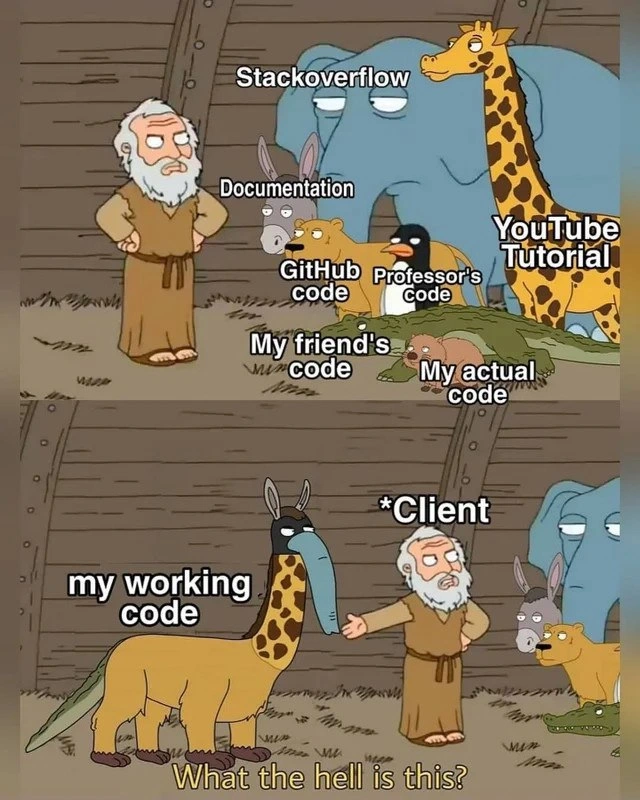
A two-panel meme using a scene from the animated TV show 'Family Guy' depicting Noah's Ark. In the top panel, Noah stands with his hands on his hips, observing a line of animals ready to board the ark. Each animal or group is labeled with a common source of programming code or knowledge: a tall giraffe ('Stackoverflow'), a blue elephant behind it, a donkey ('Documentation'), a lion ('GitHub code'), a penguin ('Professor's code'), a small rodent-like creature ('My actual code'), a beaver ('My friend's code'), and a crocodile ('YouTube Tutorial'). The scene represents the disparate sources developers use. The bottom panel shows Noah, now labeled '*Client', looking aghast at a bizarre, composite creature labeled 'my working code'. This creature is a monstrous amalgam of the animals from the first panel - possessing a giraffe's neck, a donkey's ears in a mask, an elephant's trunk, and a crocodile's tail on a lion's body. The client exclaims, 'What the hell is this?'. The meme humorously illustrates how software, despite being functional, can be an ugly, chaotic mess internally, cobbled together from various external sources. It highlights the conflict between a client's perception of a finished product and the often-messy reality of its underlying codebase, which is a classic representation of accumulating technical debt
Comments
10Comment deleted
This is what happens when your project's dependencies aren't managed by a package manager, but by the developer's browser history
Client: “Can you walk me through the architecture?” Me: “Picture a giraffe with a duck bill and donkey ears - the head is a professor’s 2004 algorithm, the neck’s a ‘microservices in 5 minutes’ YouTube demo, each leg is a different Stack Overflow answer, and the tail is my 2 a.m. patch. If it squawks in prod we just call it ‘emergent design’.”
After 15 years in the industry, you realize the real miracle isn't that Noah got two of every animal on the ark - it's that your production code, assembled from 47 different Stack Overflow answers across 3 deprecated frameworks, somehow passes all integration tests while violating every SOLID principle known to computer science
This perfectly captures the journey from 'elegant Stack Overflow answer with 2,847 upvotes' to 'production code that somehow passes CI/CD despite violating every SOLID principle and containing three different date libraries because each tutorial used a different one.' The client's reaction is especially accurate - they don't care that your code is a chimeric horror of nested ternaries and global state; they just want to know why the button is slightly off-center
Not tech debt - it's a multi-vendor microservices chimera where each limb scales independently to its SO thread
StackOverflow-first architecture: eventual consistency between a YouTube tutorial, two GitHub gists, and my glue code - client sees a chimera; I call it MVP shipped
Behold SODD architecture: StackOverflow head, tutorial neck, GitHub legs - ships as “working code” until the client’s WTF/min dashboard hits p99
this is me Comment deleted
Who exactly from this image is you? Comment deleted
$ErrorAction = Continue Comment deleted