
Over-engineering 101: Neural Networks for Basic Arithmetic
Description
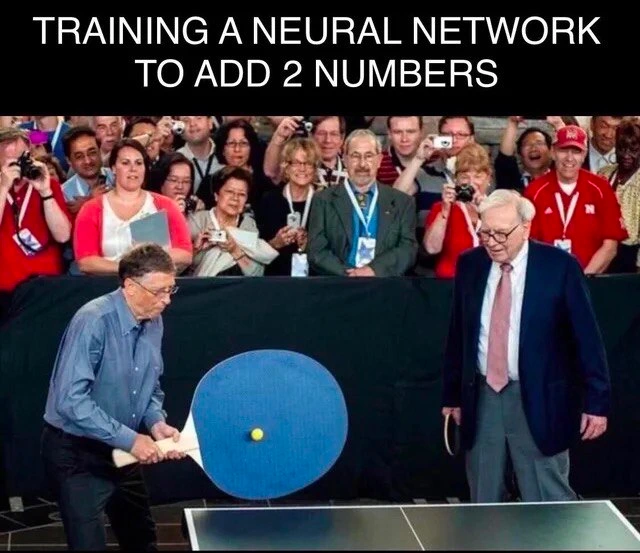
A meme featuring a photograph of Bill Gates and Warren Buffett playing table tennis in front of an audience. A large, bold text overlay at the top reads, 'TRAINING A NEURAL NETWORK TO ADD 2 NUMBERS'. In the photo, Bill Gates is on the left, humorously wielding a giant, oversized blue ping-pong paddle, while Warren Buffett stands on the right with a standard-sized one. The image captures the absurdity of using an incredibly powerful and complex tool for a trivially simple task. The technical context is a satirical critique of the hype-driven tendency in the tech industry to apply complex solutions like machine learning or neural networks to problems that can be solved with simple, deterministic code. For experienced engineers, it’s a relatable jab at over-engineering and a reminder of the importance of selecting appropriate tools, questioning whether the complexity of a solution is justified by the problem's requirements

Comments
8Comment deleted
After three weeks and a $50,000 cloud bill, the model proudly infers that 2 + 2 is approximately 3.99999987. We've declared it a success and are now seeking funding for a subtraction model
Deployed 8,192 GPUs so our transformer can approximate x + y - because why use the ALU when you can swing a warehouse-sized paddle at a ping-pong ball?
After 500 epochs, the model achieved 99.8% accuracy at returning the ball but still insists that 2+2 equals a backhand slice to the corner
After 10,000 epochs and a $40k GPU bill, the model confidently predicts 2 + 2 = 3.99987 - ship it, that's within tolerance
This perfectly captures the modern ML engineer's dilemma: spending three weeks tuning hyperparameters, provisioning GPU clusters, and debugging gradient descent convergence issues to solve a problem that literally compiles down to a single ADD instruction. Bonus points if they wrote a 47-page architecture document justifying why they needed a transformer model with attention mechanisms for integer addition
We turned x+y into a platform problem: 8 GPUs, a feature store, and a pager so the model confidently returns 3.9997 - because O(1) isn’t cloud-native
If your addition service needs a GPU, a feature store, and an on-call rotation, the + operator probably has better p99s and a smaller carbon footprint
NNs need GPU farms and epochs for 2+2; Gates and Buffett just rally it out in one serve