
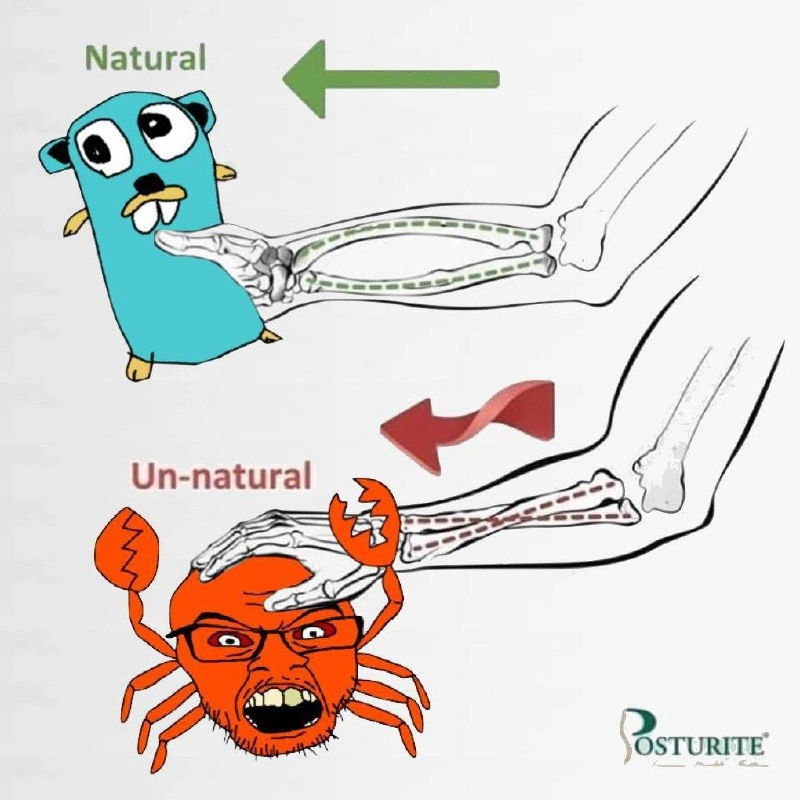
Developer Ergonomics: The Go vs. Rust Experience
Description
This two-panel meme uses an ergonomic diagram of a forearm to humorously contrast the developer experience of Go and Rust. The top panel, labeled 'Natural,' shows the Go language mascot, a friendly blue gopher, holding a forearm where the radius and ulna bones are parallel and relaxed. This represents Go's reputation for having a simple, straightforward concurrency model that is easy to learn and use. The bottom panel, labeled 'Un-natural,' features an angry-looking orange crab (the unofficial mascot for Rust) holding a forearm where the bones are twisted and crossed over each other, an awkward and strained position. This illustrates the common perception of Rust's steep learning curve, particularly its complex ownership and borrow checker rules, which, while powerful for guaranteeing memory safety, can feel convoluted and 'un-natural' to developers accustomed to other languages. The 'Posturite' logo in the corner indicates the original source was a genuine ergonomic illustration
Comments
17Comment deleted
Go's concurrency model is ergonomically designed for developer comfort. Rust's borrow checker provides superior protection but gives your brain carpal tunnel just thinking about lifetimes
Go keeps your wrists in neutral, but Rust makes you twist them at compile-time so production never needs a cast
After 15 years of wrestling with memory management, you either embrace Go's garbage collector like a warm hug or develop Stockholm syndrome with Rust's borrow checker - both camps insisting their joint pain is actually enlightenment
When your Go code compiles first try versus when you're debugging a goroutine deadlock at 2 AM - the gopher stays zen with its garbage collector, but you've evolved into a stressed crustacean with carpal tunnel, questioning every mutex you've ever locked. The real concurrency problem isn't in your channels; it's your arms trying to parallelize keyboard access while your spine implements a blocking wait
Go is the neutral wrist - ship fast and let the GC flex; Rust is the crab claw - awkward at first, but the borrow checker saves you from 3am segfault yoga
Go is the vertical mouse of languages - comfy in five minutes; Rust is the split keyboard - unnatural at first, until your p99 stops spiking from GC pauses
Natural: Before inheriting the legacy monolith. Unnatural: After refactoring it without tests
RSI (Rust Sanity Injury) Comment deleted
Fun fact, smaller sturgeons are very yoinkable fish because their body is almost triangularly shaped. They also don't have as many scales and the texture is surprisingly rough I don't really know why I said that... Comment deleted
been thinking to try go, is it worth it? Comment deleted
very suited for server stuff, it makes it pretty easy to create one and it keeps boilerplate at minimum Comment deleted
also I've been hearing good things about concurrency in go Comment deleted
yes, concurrency is vital for servers and goroutines make it very easy to implement it though you need to be careful with them (we’re still talking about concurrency, which needs to be prettily designed) Comment deleted
Minimal boilerplate? Are we talking about the same Go? Comment deleted
sure, maybe error handling’s repetitive, but with go you got one file one import, one handlefunc and you’re serving traffic. that’s the kind of minimalism I’m talking about Comment deleted
The parts that are already implemented in the stdlib are fairly minimalist, I won't argue with that. But once you get to implementing your actual project (be it the business logic or whatever thing you want to create that didn't already exist), I find that Go forces about as much boilerplate as C. It might make sense in a large team, where code is read more than it's written, but for a personal project, I find it insufferable Comment deleted
i don’t disagree, but when i want something up fast, i usually reach for Go. i appreciate how predictable and uniform everything is. for me, it’s a good trade-off that often feels worth it. Comment deleted