
Engineering's Naming Conventions: A Masterclass in Simplicity
Description
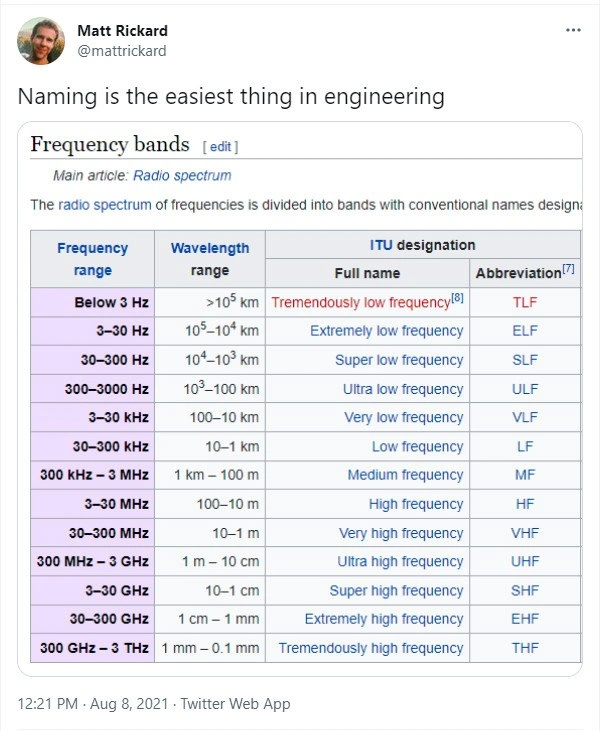
The meme is a screenshot of a tweet from user Matt Rickard, which sarcastically states, 'Naming is the easiest thing in engineering.' Below this tweet is a screenshot from a Wikipedia article titled 'Frequency bands.' The article displays a table listing the International Telecommunication Union (ITU) designations for radio spectrum frequencies. The humor lies in the naming convention shown in the table, which perfectly illustrates why naming is, in fact, one of the hardest problems. The names demonstrate a simplistic and repetitive pattern, escalating with modifiers like 'Extremely low,' 'Super low,' 'Ultra low,' 'Very low,' and then repeating the same pattern for 'high' frequencies, culminating in 'Tremendously high frequency.' For senior engineers, this is a painfully relatable example of how seemingly simple naming tasks can result in confusing and uninspired taxonomies, a problem that plagues everything from variable names to microservice architectures
Comments
26Comment deleted
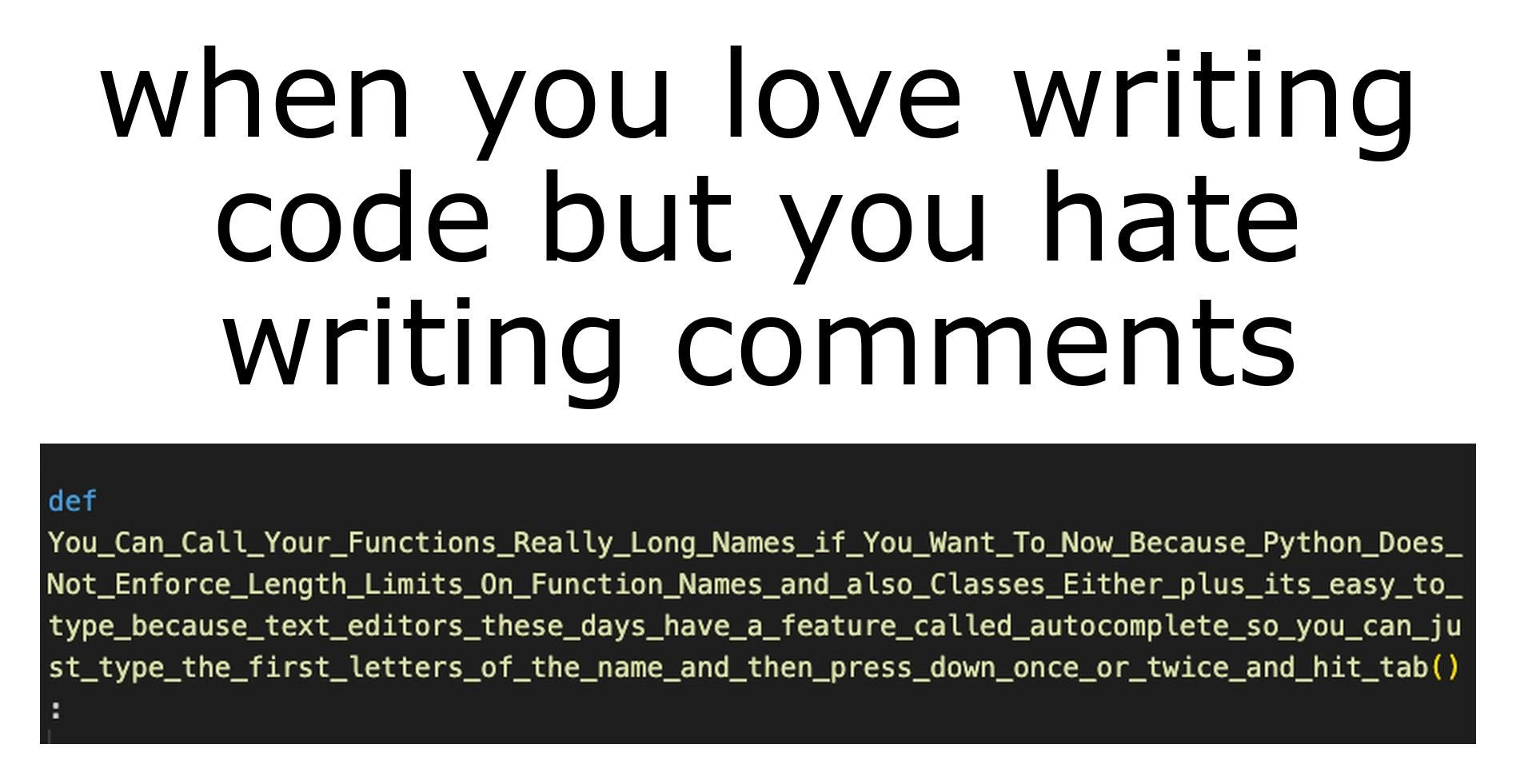
Our stack has `billing_service`, `new_billing_service`, and `nextgen_billing_service`. The first one is the only one that actually handles billing
The ITU’s spectrum table looks like the enum you get after seven rounds of code review: Low, VeryLow, UltraLow, SuperLow, TremendouslyLow - still tidier than our ServiceManagerHandlerFactoryFactory
After 20 years in tech, I've learned there are only two hard problems: cache invalidation, naming things, and apparently finding new adjectives beyond 'tremendously' when you've already used 'extremely', 'super', 'ultra', and 'very' twice in your frequency band taxonomy
Ah yes, naming things - one of the two hard problems in computer science, along with cache invalidation and off-by-one errors. This radio frequency spectrum table perfectly captures why: when your 'standard' naming convention requires distinguishing between 'tremendously,' 'extremely,' 'super,' 'ultra,' and 'very' as technical descriptors, you know someone on the ITU standards committee was having a tremendously difficult time. It's like semantic versioning, but for adjectives - and just as consistently applied. At least in software we only have to debate camelCase vs snake_case; RF engineers have to explain why 'tremendously low' is lower than 'extremely low' with a straight face
Naming done right: stacking adjectives like unchecked tech debt until 'frequency' begs for an acronym
Adjective escalation as a naming scheme - VHF/UHF/EHF/THF - is basically the original enum inflation; we just call it FooService, FooServiceV2, and FooServiceV2_UltraFinal
RF bands are what happens when a standards body bikesheds an ordinal: Low → Very → Ultra → Super… now write the ORDER BY and tell me where “Tremendously” lands without breaking prod
Ludicrous Comment deleted
Great naming policy through. Comment deleted
There would be enumerable instead if it would be made by tech. Below 3 Hz - 0 3-30 Hz - 1 ... Comment deleted
If it would be made by mathematicians, there would be no ranges, they require exact numbers Comment deleted
Strange statement Comment deleted
Sorry, not native English speaker (writer?) Comment deleted
"native speaker" works Comment deleted
doubt Comment deleted
y Comment deleted
because that's just not how it works. Those are ranges for use in communication. I'm sure mathematicians have something like this too. Comment deleted
They use powers of 10 Comment deleted
Who "they"? Comment deleted
Mathematicians. I mean without those acronyms Comment deleted
sometimes they do, sometimes they use scientific notation, sometimes they just talk about ranges, e.g. blah blah the value is in the 7th magnitude Comment deleted
(bad translation from what I know from german though) Comment deleted
I think pure mathematician will unlikely deal with frequency ranges like that Comment deleted
All I know exactly is that mathematicians would prefer as short expression as possible Comment deleted
Bonkersly low frequency Comment deleted
Why don't you call it frequency? Comment deleted