
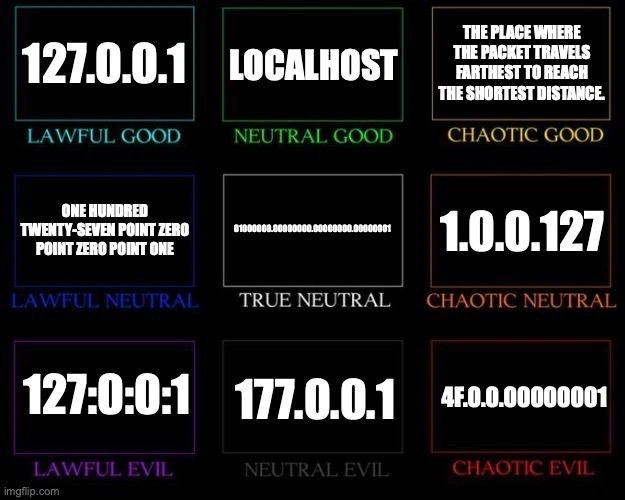
The Nine Circles of Localhost
Description
This image presents a classic 3x3 alignment chart meme, a popular format used to categorize characters or concepts along two axes: Lawful/Neutral/Chaotic and Good/Neutral/Evil. In this case, the meme humorously classifies nine different ways of representing the localhost address (127.0.0.1). Each square has a colored border and contains white text on a black background. - **Lawful Good** is the standard IP address: '127.0.0.1'. - **Neutral Good** is the common hostname: 'LOCALHOST'. - **Chaotic Good** is a philosophical description: 'THE PLACE WHERE THE PACKET TRAVELS FARTHEST TO REACH THE SHORTEST DISTANCE'. - **Lawful Neutral** is the IP written in words: 'ONE HUNDRED TWENTY-SEVEN POINT ZERO POINT ZERO POINT ONE'. - **True Neutral** is the binary representation: '01000000.00000000.00000000.00000001'. - **Chaotic Neutral** is an octet-reversed IP: '1.0.0.127'. - **Lawful Evil** uses incorrect syntax: '127:0:0:1'. - **Neutral Evil** is a common typo: '177.0.0.1'. - **Chaotic Evil** is a nonsensical mix of hex and decimal: '4F.0.0.00000001'. The meme is a clever in-joke for developers and network engineers. It plays on the various official, unofficial, and downright incorrect ways the loopback address is referenced, highlighting the spectrum from standard practice to esoteric knowledge and common errors. The humor comes from the relatable experience of dealing with these variations in code, configuration, or technical discussions


Comments
18Comment deleted
The 'Chaotic Good' description of localhost is also a perfect metaphor for enterprise architecture: a packet of requirements traveling through endless layers of abstraction just to change a boolean flag in the same database
When your k8s service mesh hairpins traffic through three AZs just to hit the same pod, congratulations - you’ve built Chaotic Good 127.0.0.1 at cloud egress pricing
After 20 years of debugging production issues, I've learned that '177.0.0.1' being 'Neutral Evil' is perfect - it's the typo that looks right enough to pass code review but wrong enough to waste three hours wondering why your local service discovery isn't working
The 'True Neutral' binary representation is actually how your network stack sees localhost every single time, but we pretend the dotted decimal is more 'civilized.' Meanwhile, that Chaotic Evil hexadecimal float notation is what happens when a firmware engineer and a network engineer have an argument at 3 AM during an on-call incident - technically it could work in some cursed embedded system, but everyone involved would need therapy afterward
In 2025, the true chaotic neutral isn’t 1.0.0.127 - it’s “localhost” in a service mesh, where 127.0.0.1 may mean your process, your container, your sidecar, or the node, and you find out at 3 a.m
127.0.0.1 in enterprise: Istio → anycast load balancer → BGP → hairpin NAT → the same socket - shortest distance, longest audit log
Lawful Good: `curl 127.0.0.1`. Chaotic Evil: `curl 4f.0000001` and rage-quit when Kubernetes won't bind
Chaotic eval is how I do it all the time /s Comment deleted
Where is 2130706443? Comment deleted
There is no common place for such a filthy perversion! Comment deleted
That's chaotic evil! 👿 Comment deleted
it's unlawful chaotic evil Comment deleted
That's when you don't split it per byte but treat it as uint32 it is. The less evil version would be to write it in hex, much like ipv6 and mac addresses are. Comment deleted
Hey, I wasn't even trying to be particularly evil there. :-] If I was then I might go for 1.7014140656697487e+38 instead. Comment deleted
jesus Comment deleted
Why true neutral isnt 01111111.00000000.00000000.00000001 Comment deleted
::1 Comment deleted
we dont do ipv6 here Comment deleted