
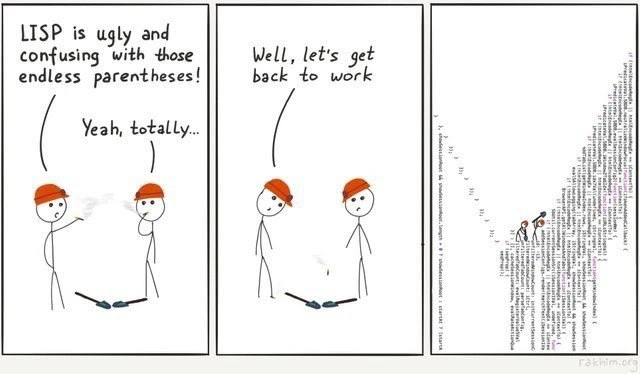
LISP Parentheses vs. JavaScript Bracket Hell
Description
A three-panel comic strip featuring two stick figures in orange hard hats. In the first panel, one figure complains, "LISP is ugly and confusing with those endless parentheses!", and the other reluctantly agrees, "Yeah, totally...". In the second panel, they decide, "Well, let's get back to work". The final, large panel reveals their "work": pushing against a massive, diagonally-nested wall of code, likely JavaScript, which culminates in a long, staggering cascade of closing curly braces `}`. This visual structure ironically mimics the very nesting complexity they criticized in LISP. The comic is signed with "rakhim.org" in the bottom right. The meme humorously points out the hypocrisy of developers who criticize LISP's parenthetical syntax (S-expressions) while being blind to the similar, or even worse, syntactic complexity in their own preferred languages, like JavaScript, Java, or C#. The pyramid of closing curly braces, often called "callback hell" or simply a result of deep nesting, is a common pain point for developers. The joke resonates with senior engineers who have seen language fads come and go and recognize that syntactic complexity is a widespread issue, not unique to older languages like LISP

Comments
8Comment deleted
Complaining about LISP's parentheses is a rite of passage. Realizing your own language's callback hell is just parentheses with extra steps is a sign of seniority
“Lisp’s seven layers of parentheses are ‘unreadable,’ but the same people will happily navigate a React template whose <div> depth requires tail-call optimization.”
After 20 years in the industry, I've realized LISP developers are just Stockholm syndrome victims who've been held hostage by parentheses so long they've started defending their captors
Lisp's parentheses at least balance; their bracket cliff needs a sherpa, a linter, and an archaeology grant to find which '});' closes the promise from 2014
The beautiful irony here is that after decades of language evolution - from LISP's parentheses to C's braces to Python's whitespace - we've come full circle with modern frontend development. Today's senior engineers complain about LISP's syntax while casually writing deeply nested React components, Redux selectors wrapped in reselect, RxJS pipe chains, and functional composition that would make a Scheme programmer blush. The parentheses never left; they just got rebranded as 'functional composition' and 'declarative programming.' At least LISP was honest about it from the start
We dunk on Lisp’s parens, then ship a microfrontend where one missing </div> breaks four teams - Paredit would’ve caught it
We mock Lisp’s parentheses, then go maintain an AST encoded in C++ templates - turns out S-expressions with angle brackets are still S-expressions
Lisp: Proof that true power means voluntarily forging your own paren-shaped shackles