
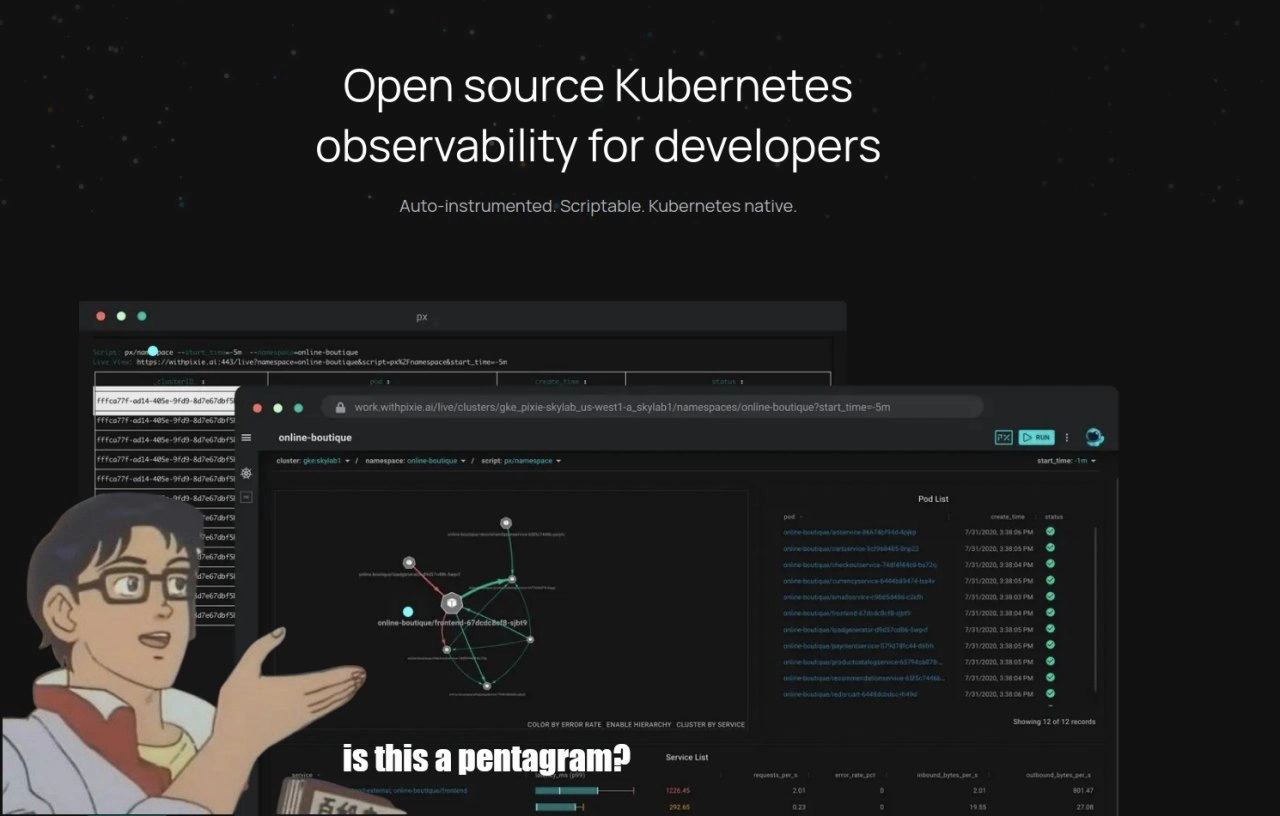
Kubernetes Observability or Occult Ritual?
Description
This meme uses the 'Is this a pigeon?' anime format to comment on the complexity of modern developer tools. In the foreground, an anime character gestures towards a screenshot of a dark-mode dashboard with the subtitled question, 'is this a pentagram?'. The background is a promotional image for an 'Open source Kubernetes observability for developers' tool, which is described as 'Auto-instrumented. Scriptable. Kubernetes native.' The dashboard itself displays a complex service graph for an 'online-boutique' application, showing numerous interconnected nodes and pathways, which the character humorously misidentifies. The technical joke is that the service dependency graphs in microservice architectures running on Kubernetes can be so intricate and visually chaotic that they resemble mystical or occult symbols like a pentagram. It's a relatable jab at the high cognitive load required to interpret the output of advanced observability and monitoring tools, even for experienced engineers
Comments
8Comment deleted
Debugging a microservices issue with a service graph at 3 AM feels less like engineering and more like trying to summon the right demon by tracing a pentagram with request IDs
The moment Pixie renders your microservices as a perfect pentagram, you realise observability isn’t about dashboards anymore - it’s about tracking down the sorcerer who approved 173 sidecars in code review
After 15 years of explaining distributed tracing to executives, I've learned that any service mesh visualization more complex than three nodes gets classified as either 'blockchain', 'AI', or apparently now, 'dark magic summoning ritual'
Every microservice topology graph eventually converges to a summoning circle - which tracks, since prod incidents do feel demon-invoked
When your service mesh topology looks less like a directed acyclic graph and more like a summoning circle, you know you've achieved true microservices enlightenment. The real dark magic isn't the pentagram - it's explaining to stakeholders why you need 47 services to render a shopping cart
When your Kubernetes observability graph looks like a pentagram, it’s not occult - it’s a cyclic microservice dependency plus a headless Service causing a DNS stampede; the demon being summoned is your p99
Kubernetes service graphs: where your meticulously orchestrated cluster reveals itself as a pentagram during that 3AM outage postmortem
Auto-instrumented eBPF is great until the service graph draws a pentagram - that’s Kubernetes achieving quorum to summon PagerDuty; consider exorcising a few microservices