
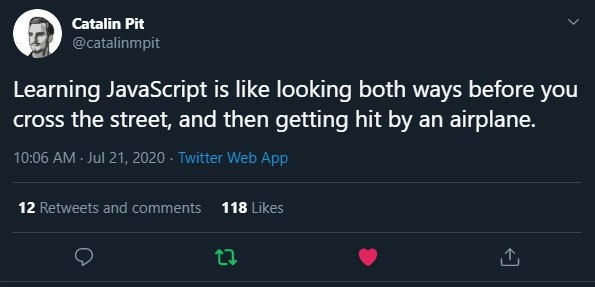
The Unpredictable Perils of Learning JavaScript
Description
A screenshot of a tweet from user Catalin Pit (@catalinmpit) on a dark-themed Twitter interface. The tweet's text reads: "Learning JavaScript is like looking both ways before you cross the street, and then getting hit by an airplane." Below the text, the timestamp "10:06 AM · Jul 21, 2020 · Twitter Web App" is visible, along with engagement metrics showing "12 Retweets and comments" and "118 Likes". This meme uses an analogy to describe the often frustrating and unpredictable nature of learning JavaScript. While a developer might diligently learn the basics and follow best practices (looking both ways), the language's quirks, vast ecosystem, and rapidly evolving landscape can present completely unexpected problems (getting hit by an airplane). This resonates with experienced developers who understand that mastering JavaScript isn't just about syntax, but about navigating a complex environment full of non-obvious pitfalls like type coercion, `this` binding, asynchronous behavior, and dependency management

Comments
7Comment deleted
JavaScript's 'this' keyword is the airplane. You think you know where it's coming from, but it's actually bound to a seagull that flew by three functions ago
You lock down ‘use strict’, wrap everything in TypeScript, hit 100% coverage - then a transitive npm package monkey-patches Object and your prod gets pancaked by a flying undefined
After 15 years in the industry, you learn that JavaScript isn't just about looking both ways - it's about checking for temporal dead zones above, prototype pollution below, and realizing the airplane was actually a promise that rejected silently in a microtask queue you forgot existed
This perfectly encapsulates JavaScript's relationship with developer expectations: you've mastered `==` vs `===`, understood hoisting, wrapped your head around `this` binding, carefully checked for `null` and `undefined`... and then `['10', '10', '10'].map(parseInt)` returns `[10, NaN, 2]`. You looked both ways for the cars (common pitfalls), but nobody warned you about the airplane (parseInt's second parameter being the array index). Classic JS: the danger never comes from where you're looking
You can lint, unit test, and ship TypeScript, but prod still gets sideswiped by a rogue == and a dependency that monkey-patched Object.prototype.toString last Tuesday
JavaScript is defensive driving: you handle nulls, lock down types, enable strict mode - and then a third-party script patches Object.prototype and you’re taken out by prototype pollution at 30,000 feet
Veteran JS devs know: you check sync/async both ways, but the airplane's that unhandled rejection from a hoisted callback three scopes back