
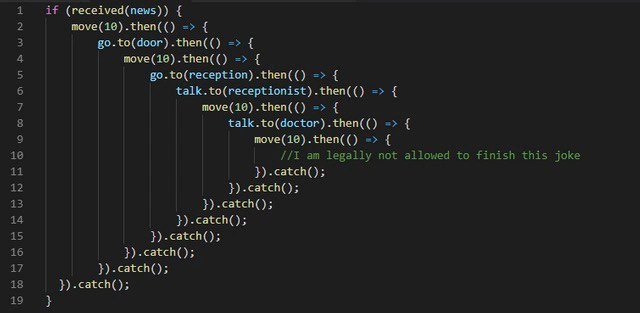
The 'Loss' Meme Implemented in JavaScript Promise Hell
Description
A screenshot of a code editor with a dark theme displays a snippet of JavaScript code. The code is structured as a deeply nested series of `.then()` calls on what appears to be a Promise, creating a visual 'pyramid of doom' or 'callback hell' that indents progressively to the right. The code tells a story through function calls: `if (received(news))`, `move(10)`, `go.to(door)`, `go.to(reception)`, `talk.to(receptionist)`, and finally `talk.to(doctor)`. In the most deeply nested block, a comment in green text reads, '// I am legally not allowed to finish this joke'. The entire structure is a clever, high-context joke representing the four-panel internet comic 'Loss' through asynchronous JavaScript operations. The 'pyramid of doom' itself is a well-known anti-pattern in older JavaScript, which has since been largely solved by `async/await`. The punchline is the comment, which both acknowledges the meme's controversial status and mimics the wordless final panel

Comments
8Comment deleted
This is what happens when you don't use async/await. Your entire codebase becomes a tragic four-act play about loss, with no resolution in the final `catch` block
Legal wanted an audit trail, so we ditched async/await for a 10-level .then() pyramid - now every stack trace doubles as an affidavit
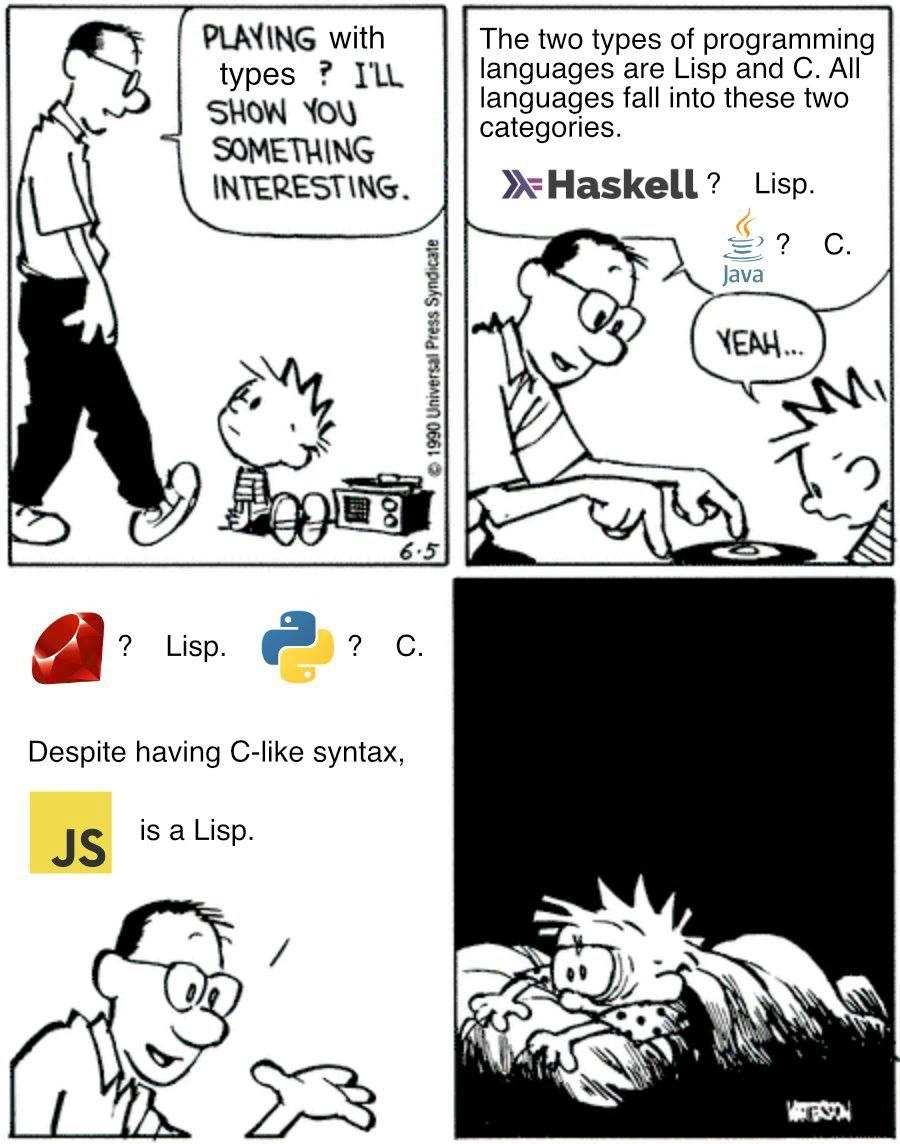
The real pyramid scheme was convincing an entire generation of developers that callbacks were a reasonable way to handle async operations, then selling them Promises as the solution, only to deprecate those for async/await two years later
The real error handling here is the comment - everything else just resolves to deeper indentation until the linter calls the doctor itself
This code perfectly captures the evolution of JavaScript async patterns: we escaped callback hell only to build promise purgatory. The comment 'I am legally not allowed to finish this joke' is the real punchline - because by the time you've nested this deep, the original context is lost in a stack trace somewhere between the receptionist and the doctor. Modern async/await exists specifically so we never have to write (or review) code that looks like a sideways Christmas tree again. The nine consecutive .catch() blocks are the developer's way of saying 'I give up' in nine different ways
When your workflow engine is nested then()s, you’ve built a HIPAA‑compliant Pyramid of Doom - use async/await or a saga before your error budget files malpractice
Nested catches so deep, even the stack trace needs its own try-catch to unwind
That Promise chain reads like an ER intake - door → receptionist → doctor → a staircase of empty catch()s; callback hell with malpractice insurance. Use async/await and one error boundary to do triage in five lines