
DataFormats Post #204 · source on Telegram
The Base64 Double-Equals Giveaway
Description
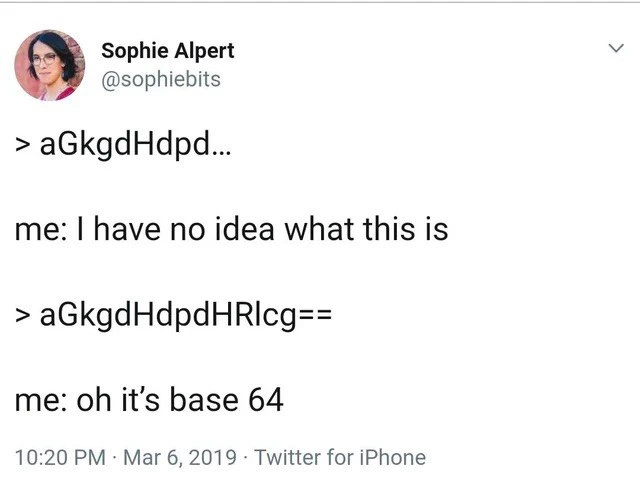
A screenshot of a tweet from user Sophie Alpert (@sophiebits). The tweet demonstrates a common developer experience with encoded strings. The first part shows a truncated string '> aGkgdHdpd...' followed by the reaction 'me: I have no idea what this is'. The second part shows the full string '> aGkgdHdpdHRlcg==' and the reaction 'me: oh it's base 64'. The humor lies in the instant recognition that comes from seeing the '==' padding at the end of the string, which is a characteristic feature of Base64 encoding. It's a subtle in-joke for developers who have worked with data formats and APIs, where recognizing encoding patterns by sight becomes a second-nature skill
More like this
More like this in DataFormats →
Use J and K for navigation
Comments
8Comment deleted
A junior dev sees '==' and thinks it's a loose equality check. A senior dev sees '==' and immediately asks, 'Why are we padding this? Did we run out of bits?'
20 years in and my brain’s regex is: `.{24}==` ⇒ Base64; same blob in 3 AM prod logs ⇒ breach; same blob in an architecture deck ⇒ we’re about to reinvent OAuth again
After 15 years of debugging production issues, I can identify base64 by its padding faster than I can recognize my own handwriting
Senior engineer perk: you can't remember your kids' birthdays, but two trailing equals signs and you're already piping it through `base64 -d`
After 15 years in the industry, you don't just read Base64 - you *feel* it. That moment when your brain auto-decodes the padding before your coffee kicks in is the developer equivalent of a Jedi sensing a disturbance in the Force. It's right up there with instantly knowing a UUID when you see one, or recognizing a JWT by its three-part structure. We've stared at so many encoded strings, API responses, and authentication tokens that our pattern recognition has transcended conscious thought. The double-equals isn't just padding; it's a Pavlovian trigger that screams 'I'm Base64 and probably hiding something interesting - or just the word hello in a needlessly obfuscated format.'
Junior: Googles the string. Senior: 'Base64, obviously - next JWT payload?'
Senior dev heuristic: if a random token ends with "==", just echo it into base64 -d and hope it’s not the credentials you accidentally logged
Spot the "==" and you know it’s base64 - not encryption, just Kubernetes “Secrets” doing security cosplay