
HTMX's Simplicity vs. React Server Components' Existential Complexity
Description
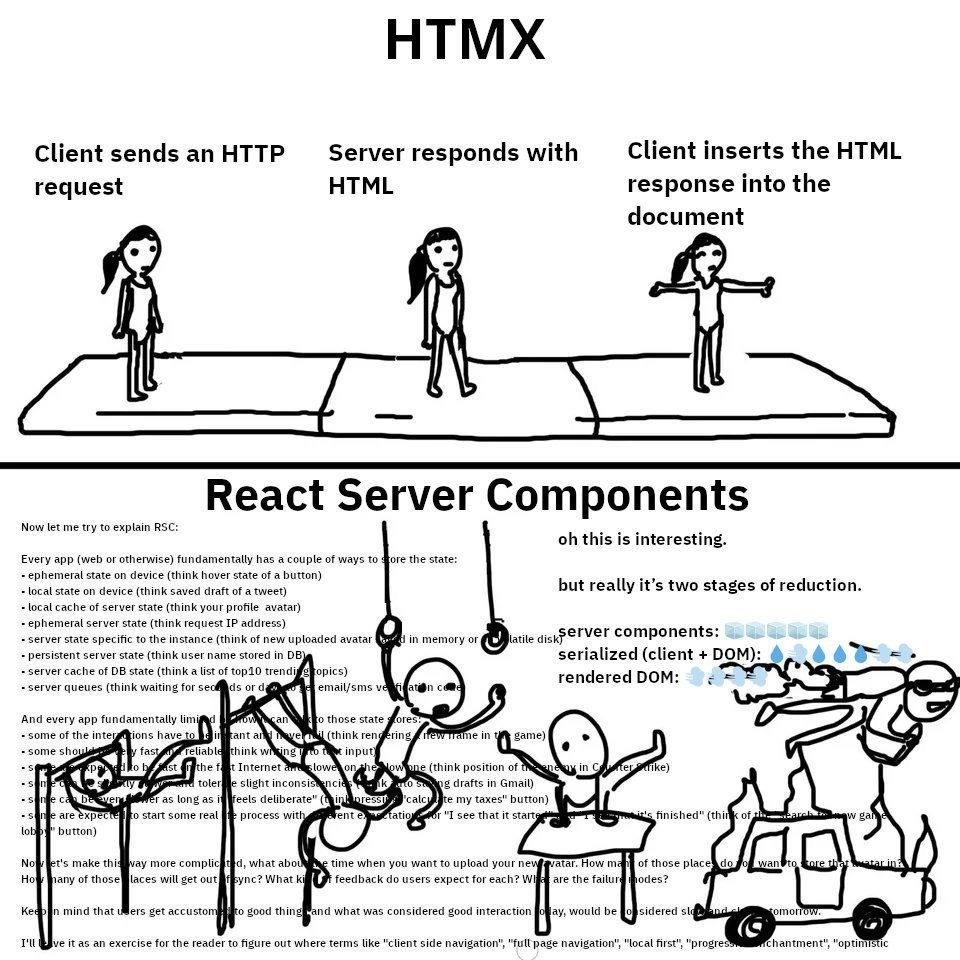
This is a two-panel comparison meme that contrasts the perceived simplicity of HTMX with the perceived complexity of React Server Components (RSC). The top panel, labeled 'HTMX,' uses a simple three-frame comic strip to illustrate its process: 1. 'Client sends an HTTP request,' 2. 'Server responds with HTML,' and 3. 'Client inserts the HTML response into the document.' The visuals are clean, with simple stick figures on a linear path. The bottom panel, labeled 'React Server Components,' is a chaotic, surreal, and densely packed illustration. It's filled with an overwhelming wall of text that begins, 'Now let me try to explain RSC:' and lists numerous, complex types of application state (ephemeral, local, persistent, server cache, etc.). The accompanying imagery is frantic, showing stick figures entangled in bizarre contraptions, being sprayed with water (labeled 'rendered DOM'), and driving a car, all meant to represent the convoluted nature of RSC's architecture. The meme humorously critiques RSC as being over-engineered and difficult to grasp, while positioning HTMX as a refreshingly straightforward alternative in the world of web development

Comments
36Comment deleted
Explaining HTMX takes one sentence. Explaining React Server Components requires a ten-part blog series, a PhD in distributed systems, and a support group for the engineers who have to maintain it
HTMX is basically cURL with a DOM patch, while RSC feels like you accidentally rebuilt CORBA in JSX just to toggle a CSS class
After 15 years of progressively enhancing JavaScript frameworks to handle server-side rendering, we've finally innovated our way back to... sending HTML over the wire. The only difference is now we need a PhD in distributed systems to understand the hydration boundaries
When your framework's explanation requires a PhD thesis and hand-drawn stick figures to convey the mounting existential dread, while the alternative is literally 'server sends HTML, browser shows it' - maybe we've overcomplicated the web. RSC advocates will spend 20 minutes explaining why their two-stage reduction with serialized component trees is actually simpler than a POST request, and honestly, watching them try is the real entertainment value here
HTMX ships markup; RSC ships markup after crossing a serialization boundary, streaming pipeline, hydration ritual, and two caches - because a button click shouldn’t happen until the architecture diagram does
HTMX: POST -> innerHTML; RSC: Flight payload -> streaming shell -> hydrate client boundaries -> debate cache ownership - all to render the same dropdown
HTMX: Server owns state, browser renders happy. React: State's an exercise left to the reader - client cache, server serializer, or dev's nightmares?
Despite React being the front-end equivalent of PHP, and Redux being significantly worse, the first approach is only suitable for certain student tasks. Comment deleted
Use Dioxus instead - full stack in pure Rust for all 5 platforms Comment deleted
and horribly wrong rendering in terminal and DOM reimplementation Comment deleted
I yearn to bring back the Web 2.0 times, when the best web designers could do were some fancy shapes and pastel colors, yet the websites only took a couple of seconds to load even on single core 6W Atom Z CPUs Comment deleted
One can still achieve it. Use vanilla JS (or with absolute minimum foreign libraries if needed), no JS framework of any kind. Use custom written clean HTML. And you're done! Comment deleted
see, you've perfectly described the issue nobody does that anymore Comment deleted
Billions of CPU cycles wasted on processing and rendering shite... Comment deleted
It's not even shite, it's just bad code written in unfairly popular (bc they have an absurdly low barrier of entry) frameworks, that haven't been refactored and optimized since initial public release some 5-10 years ago, and are themselves written in fucking Python in the best case scenario to begin with Comment deleted
I know a multiple cases of huge performance gains happening just from adding index to table... Damn active model... Add index and boom, suddenly queries are orders of magnitude faster. And docs & examples don't show nor tell would-be-devs that this shite ain't gonna optimize itself. Comment deleted
I think, most if not all actually talented software/hardware engineers heavily suffer from teacher paradox syndrome. It's very easy to gloss over a very minor, but important thing, when explaining something you find extremely simple to somebody who doesn't understand the principle. And it's even hard to come up with a simple enough and understandable explaination in the first place. Using any kind of math makes things infinitely less understandable. And that's on top of the fact modern code monkeys don't get taught to think in algorithms. I'm a relatively inexperienced project manager (bachelors major in production plant management, minor in cellular biology, lmao) with some rudimentary C# skills that i use for personal applied automation, yet somehow i know more about how software works than like 90% of CS bachelor juniors coming in. What the actual fuck? Comment deleted
And you will spend 3x-10x more time to achieve the same (or even worse) results, encountering countless bugs and lacking cross-platform/cross-browser compatibility. The days when everyone used only IE at a 1920x1080 resolution are long gone. For a school pet project, pure JavaScript will suffice. However, for anything more significant, you've already lost. Comment deleted
Bro, don’t even start trying to defend js web-frameworks Comment deleted
Oh, I'm not defending frameworks - they already create better-performing code than 99% of developers can with vanilla JS for any real project. Even if vanilla fans drop cross-browser and cross-platform support. It's like old "I'll code it in ASM." Comment deleted
”Honey, it’s time for your 40kb simple dropdown script loading” yeah, seems pretty better-performing Comment deleted
Sorry, I'm too busy doing another absolutely useless 64k asm demo. Comment deleted
Maybe 3x but not more. Supporting old shit is not needed anyway. And your misconception about IE as most used browser in fhd era only shows how young and inexperienced you really are 😉 Comment deleted
During 2000-2007, IE dominated the browser market with > 80% share and half of this time even > 90%, being the most advanced option available. While W3C was just beginning to discuss new standards, IE was already implementing these features. Comment deleted
https://gs.statcounter.com/screen-resolution-stats/desktop/worldwide/2010 I told you you have no idea about resolution used in IE era Comment deleted
But I agree that it was most likely 1024x768. I've already started to forget the exact details. The point was the dominance of one desktop resolution. Comment deleted
So what's the problem anyway? responsive design is easy. Css media queries are very cool, so what's the point? Comment deleted
I'd rather have Web1.0, if that. Kthnxbye. https://drewdevault.com/2020/03/18/Reckless-limitless-scope.html Comment deleted
Nobody use Redux anymore Comment deleted
GOD! I have faith! You've heard my prayers and cleansed the world of this scourge of absurdity! The previous ones were XML/XSLT. These two were able to reduce both server and client to mere rocks. Comment deleted
TBF I would have preferred XHTML over what we got with HTML5. But that's a such low bar that it's detectable only with a scanning electron microscope. Comment deleted
done Comment deleted
I can understand Svelte or anything written not in javascript, because it at the very least TRIES to optimise what you’re doing Comment deleted
A good dev will be able to create very well performing stuff in pretty much everything. A bad dev, while kinda-sorta able to stick together something from copy-pasted examples and stack-overflow (and chatgpt) answers, won't be able to create anything without the nice framework :) Comment deleted
Also - in ye olde days, jquery was a godsend because have fun trying to do stuff cross-browser. Now, vanilla js is great because you can do everything pretty much on point. And yet jquery is still being used. Comment deleted
Exactly. I showed you the link where even in the 2010 the 1920x1080 is less than 5%. You can imagine that 3 years earlier it was even less. Comment deleted