
The Unrefined Nature of Global Variables
Description
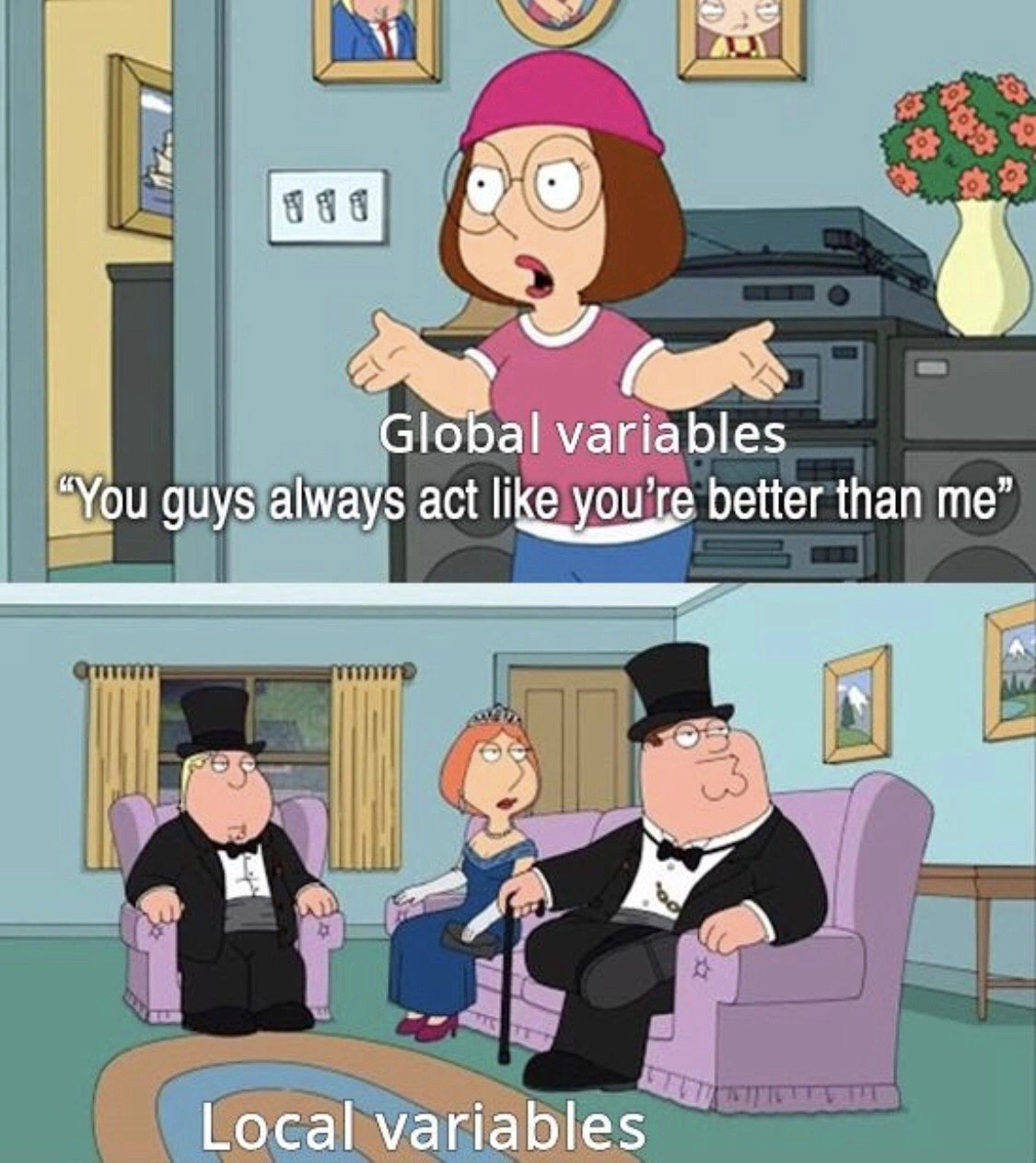
A two-panel meme from the animated series 'Family Guy' contrasts global and local variables. The top panel features the character Meg Griffin, looking exasperated, with the label 'Global variables'. Below her is the quote, 'You guys always act like you're better than me'. The bottom panel shows other members of the Griffin family - Peter, Lois, and Chris - dressed in sophisticated, formal attire, including top hats and a tiara, looking down with an air of superiority. This panel is labeled 'Local variables'. The meme humorously personifies a fundamental programming concept: the preference for local variables over global ones. Global variables, which can be accessed and modified from anywhere in a program, are often considered poor practice as they can lead to unpredictable side effects and make code difficult to debug and maintain. Local variables, with their limited scope, are seen as the cleaner, safer, and therefore 'better' choice, perfectly captured by the Griffin family's smug, aristocratic portrayal


Comments
9Comment deleted
A global variable is like a public toilet: you don't know who used it last, what state they left it in, and you're pretty sure touching it will cause unexpected side effects
Globals keep crying class warfare, but after you’ve seen one race condition smear their stale state across 200 threads, a little stack-based aristocracy feels well-deserved
Global variables are like that one senior engineer who still has write access to prod from 2008 and everyone's too afraid to revoke it because half the cron jobs might break
This meme perfectly captures the architectural snobbery around variable scope - global variables are the Meg Griffin of programming: universally accessible, frequently modified by everyone, and constantly blamed when things go wrong. Meanwhile, local variables sit in their encapsulated ivory towers with proper lifetime management and predictable state, smugly adhering to the principle of least privilege. The real irony? Both are just memory addresses with delusions of grandeur, but one has better PR and doesn't cause race conditions at 3 AM in production
Globals are why your tests pass individually and flake in parallel; locals arrive with DI, reentrancy, and a clean exit
Global variables are shared mutable state with a company-wide blast radius; local variables are scoped, deterministic, and classy enough to leave before the postmortem
Globals: singletons on steroids, crashing every party. Locals: scoped nobility, zero state leaks
Haskell: what the hell are you, variables? Comment deleted
Pascal: "WTF, WHY DO YOU EXIST LOCAL SHIT" Comment deleted