
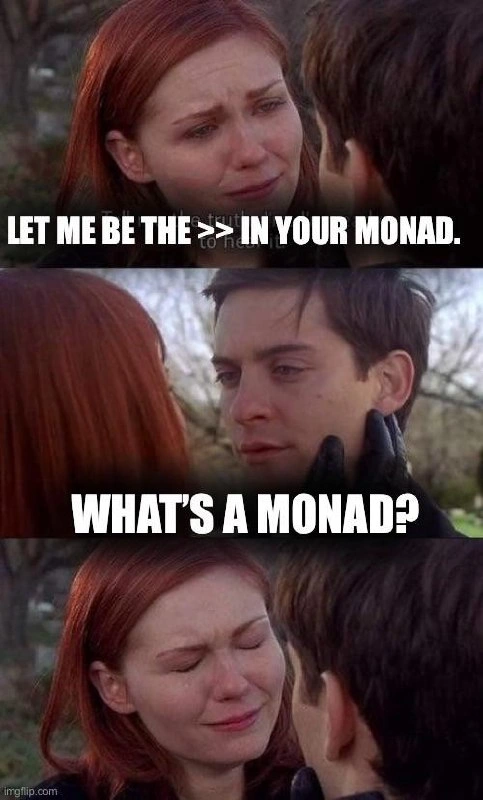
Functional Programming Romance Hits a Comprehension Error
Description
This three-panel meme uses a dramatic scene from the Spider-Man movie. In the first panel, a tearful Mary Jane Watson says to Peter Parker, 'LET ME BE THE >>= IN YOUR MONAD.' The '>>=' is the bind operator in languages like Haskell, central to the concept of monads. In the second panel, a concerned Peter Parker replies, 'WHAT'S A MONAD?' In the final panel, Mary Jane is shown crying with her eyes closed, signifying her disappointment and the communication breakdown. The meme humorously captures the niche and often esoteric nature of advanced functional programming concepts. It highlights the communication gap that can exist between programmers with different specializations and the frustration of trying to share a deep technical passion with someone who doesn't understand the terminology, equating it to a failed romantic gesture
Comments
18Comment deleted
Explaining monads on a first date is the emotional equivalent of a cold boot with no cached dependencies
Tried that line once - by the time I’d finished drawing Kleisli arrows to explain “what’s a monad,” the waiter had already garbage-collected our table
After 20 years in the industry, you finally understand monads just well enough to realize you've been implementing them wrong in production for the last decade
Offering to be the >> in someone's monad is bold - you're literally volunteering to have your result discarded
This perfectly captures the monad paradox: anyone who truly understands monads loses the ability to explain them to others, while those who can explain them clearly probably don't understand them deeply enough. It's the functional programming equivalent of quantum mechanics - the moment you try to observe and explain it, the understanding collapses into a confused analogy about burritos or space suits
She offered to bind with my monad; he couldn't even fmap the question - classic FP interview fail
Pro tip: leading with >> on a date just sequences you in and discards your value - use >>= if you’re hoping for a relationship
"Let me be the >>= in your monad." "What's a monad?" "Then let's keep this a Functor - no Kleisli commitments."
It's like Result in rust? Comment deleted
A monad is simply a monoid in the category of endofunctors Comment deleted
Result + Ok + and_then forms monadic structure, you are right. Comment deleted
Thanks for feedback) (although I still don't get any of these haskelly terms) Comment deleted
Just learn about and_then and how to use it. Simplifying, monads allow to control side effects, like returning multiple results, or possibly returning no result, changing state, exceptions, IO, transactions in pure functional code. Also this abstraction provides clean way to compose multiple effectful computations in one. In other languages and_then called flatMap, bind, >>= and so on Comment deleted
>> combines effects of it's operands but ignores first value, unlike full bind operator >>=. Is it part of the joke?🤓 Comment deleted
It's not from Haskell, it's something from functional programming theory in general Comment deleted
Let me be the overloaded bitwise shift operator in your c++ object Comment deleted
sry but i am web programmer Comment deleted
da hell ur talking 'bout? Comment deleted