
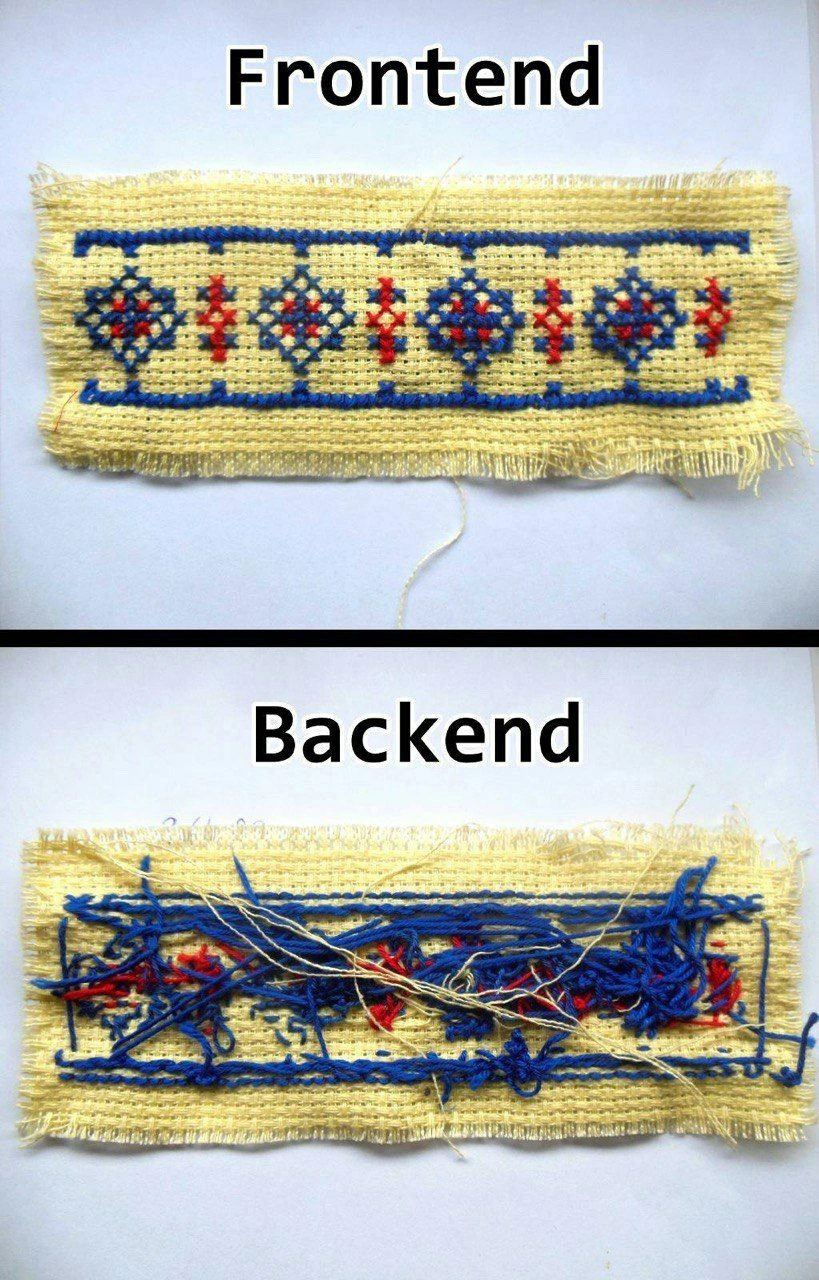
Frontend Elegance vs. Backend Reality
Description
A two-panel meme comparing software development to embroidery. The top panel, labeled "Frontend," displays a beautiful, orderly cross-stitch pattern on a piece of yellow fabric. The design is symmetrical and uses red, white, and blue thread. The bottom panel, labeled "Backend," shows the reverse side of the same piece of fabric. It's a chaotic mess of tangled threads, knots, and loose ends, revealing the hidden complexity required to produce the clean result on the front. The meme humorously illustrates the common reality where a polished user interface (frontend) is supported by a complex, often messy, server-side infrastructure (backend). For senior developers, this is a relatable analogy for how systems are architected - what the user sees is a carefully managed abstraction, while the underlying implementation can be a tangled web of services, legacy code, and quick fixes that somehow work together

Comments
8Comment deleted
The frontend is the meticulously curated REST API response. The backend is the series of shell scripts, cron jobs, and a Perl script from 1998 that generates it
The React UI is a hand-stitched masterpiece - just don’t flip it over or you’ll spot the knotted goroutines, Kafka retries, and that one cron job called “temp_patch.sh” we’re all pretending isn’t the only thing keeping prod alive
The frontend is just the backend with a really good PR team and a restraining order against anyone who tries to look under the hood
Every system is beautiful at the API boundary; flip it over and you find the threads marked 'TODO: untangle before launch' - dated three launches ago
This embroidery perfectly captures the essence of full-stack development: the frontend is what you show in demos and put on your portfolio, while the backend is what you frantically refactor at 2 AM before the code review, hoping no one asks about that nested callback hell holding together your 'microservices architecture.' The real artistry isn't in the pattern users see - it's in making that tangled mess of threads somehow produce a coherent, beautiful interface without unraveling completely when someone changes a single dependency version
Frontend: pixel-perfect stitches. Backend: thread dump masterpiece holding prod together
That “Frontend” is the Figma screenshot; the “Backend” is the anti‑corruption layer, three cronjobs, two compensating transactions, and five TODOs marked “temp until after launch” - now in year six
Frontend is pixel-perfect; backend is a decade of compensating transactions stitched with cron jobs, DB triggers, and a queue named “retry-forever.”