
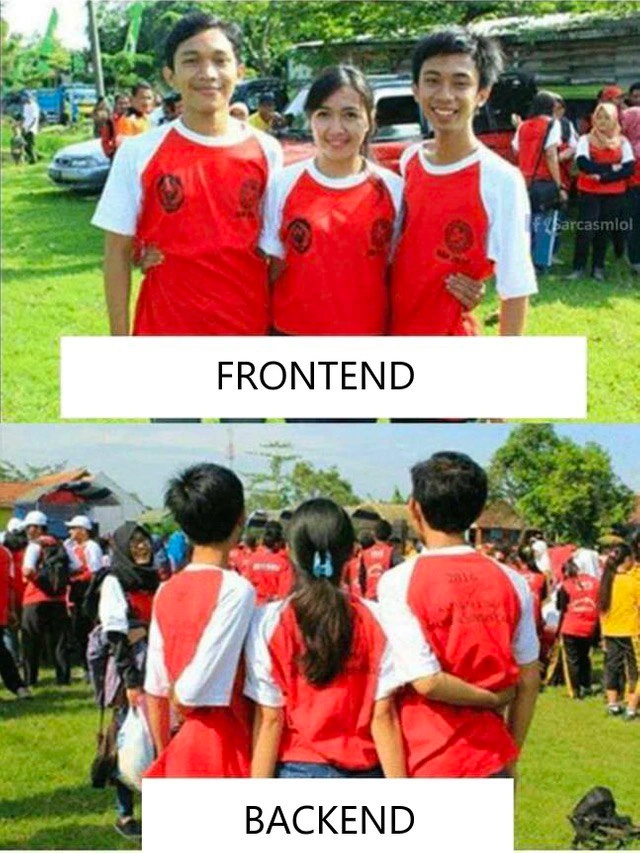
Frontend presentation vs. backend reality
Description
A two-panel meme contrasting frontend and backend development. The top panel, labeled 'FRONTEND', shows two young men and a young woman standing together, smiling nicely for the camera in matching red and white shirts, appearing well-organized and friendly. The bottom panel, labeled 'BACKEND', shows the same three individuals from behind. In this view, it's revealed that the two men have their arms linked or are holding hands behind the woman's back, unbeknownst to her. This meme uses a visual metaphor to explain the difference between the polished, user-facing part of an application (the frontend) and the often complex, messy, or intricately connected inner workings that are hidden from view (the backend). The joke resonates with developers who know that a simple UI can conceal a vast amount of convoluted logic and dependencies


Comments
7Comment deleted
The frontend is the clean API gateway. The backend is the tangle of legacy SOAP services, a critical Excel macro running on a server under someone's desk, and three different message queues that make it all work
Code review tip: if the UI demo gets unanimous applause, flip the file tree around - there’s probably an arm coming through a shirt sleeve somewhere in /services
Frontend code: meticulously commented, linted, and tested. Backend code: held together by a Dockerfile from 2019 and a prayer that nobody touches the load balancer config
The eternal truth of web development: frontend gets all the glory and user feedback, while backend does the heavy lifting in obscurity - until something breaks at 3 AM, then suddenly everyone remembers the backend exists. It's like being a stage crew member: when everything works perfectly, nobody notices you; when one thing fails, everyone knows exactly who to blame
Your diagram shows clean boundaries; in prod the back end is two services hugging through shared mutable state, a nightly cron, and one undocumented trigger - decoupling is strictly front‑of‑house
Every sprint review: pixel‑perfect frontend; behind it, two “microservices” hug each other with circular HTTP calls and a shared table named temp_fix_2018
Frontend: Three devs tweaking pixels. Backend: Silent legion scaling to Black Friday traffic