
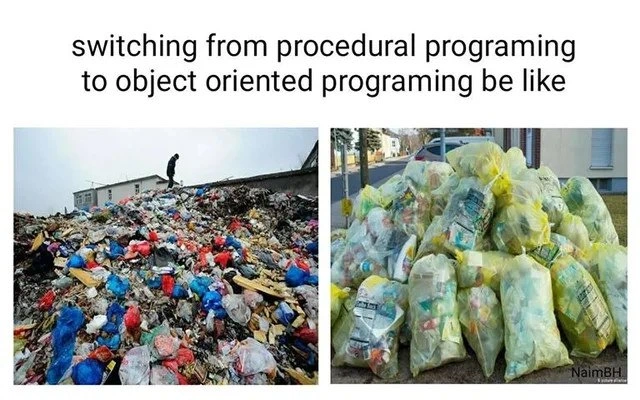
OOP vs procedural: same garbage, just wrapped in tidy classes
Description
A white-background meme displays the caption "switching from procedural programing to object oriented programing be like" in simple black text across the top. Below, two photographs sit side-by-side: on the left, an enormous, chaotic landfill of multicolored trash with a lone person walking across the heap; on the right, the same kind of refuse is sealed in many translucent yellow garbage bags and stacked neatly on a curb. The visual gag contrasts uncontained clutter with neatly packaged waste, implying that object-oriented programming merely encapsulates underlying mess rather than eliminating it. For developers, the meme humorously critiques how moving from procedural to OOP can turn spaghetti code into class-based garbage - cleaner interfaces but the same questionable logic underneath. It resonates with code-quality debates, encapsulation trade-offs, and the perennial struggle to turn legacy chaos into maintainable structures
Comments
6Comment deleted
Refactoring legacy C into OOP is like shrink-wrapping the landfill and calling it a domain model: the stench is now private, but every public method still leaks methane
OOP: where your garbage is still garbage, but now it's wrapped in transparent bags so everyone can see exactly whose fault it is when production breaks
The meme brilliantly captures the existential realization that switching to OOP doesn't eliminate complexity - it just gives you prettier containers for your mess. You've gone from global state scattered everywhere to tightly-coupled objects passing around mutable references, but hey, at least now your garbage has encapsulation and you can pretend those yellow bags are 'abstraction layers.' The real joke? Both landfills still need garbage collection, but only one paradigm named the cleanup process after itself
Procedural: one 10k-line landfill(); OOP: same garbage, now wrapped in classes - Garbage extends Waste, created by WasteFactory and injected into TrashService; smells the same, but it’s SOLID
Procedural: one sprawling main() dump. OOP: factories churning out subclassed trash bags - same heap, fancier polymorphism
We didn’t refactor; we encapsulated - now the landfill has 97 classes, 12 interfaces, a factory per bag, and one God Object orchestrating garbage collection