
Explaining Machine Learning to Clients, Simplified
Description
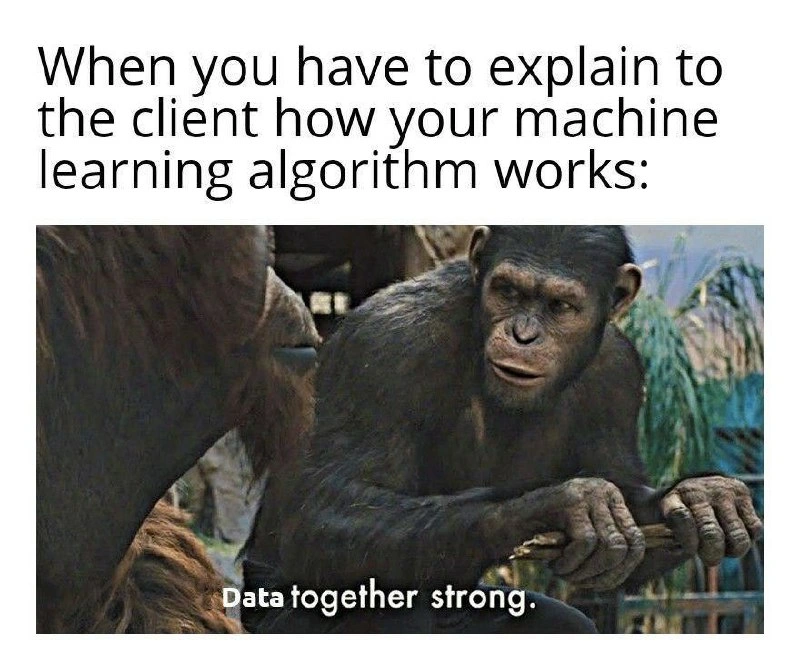
This meme captures the challenge of explaining complex technical concepts to a non-technical audience. The top text reads, 'When you have to explain to the client how your machine learning algorithm works:'. Below this is a still image of Caesar, the intelligent ape from the movie 'Rise of the Planet of the Apes.' Caesar is shown in a thoughtful pose, communicating a simple but profound idea. The subtitled text at the bottom reads, 'Data together strong.' The humor comes from the gross oversimplification. Instead of delving into the intricacies of neural networks, gradient descent, or feature engineering, the explanation is reduced to a primal, broken-English phrase that is comically basic yet, in essence, true. For data scientists and ML engineers, it's a deeply relatable scenario of bridging a massive knowledge gap with stakeholders who need a high-level concept, not a technical deep dive


Comments
14Comment deleted
Client: 'So it's like a super-smart Excel macro?' Me: '...Yes. A very, very strong macro.'
Some days you craft a 50-page LIME report; other days you channel Caesar and declare, “Data together strong,” and somehow the QBR slides themselves converge
After 20 years in the industry, you realize the hardest distributed system to debug isn't your Kubernetes cluster or your eventual consistency model - it's the distributed understanding of what your ML model actually does across the C-suite, where each executive has their own strongly consistent but completely wrong mental model of 'AI magic.'
'Data together strong' is honestly a more accurate explanation of gradient descent than most slide decks - and unlike the model card, the client understood it
When your carefully architected ensemble of gradient-boosted decision trees with hyperparameter-tuned regularization gets reduced to 'we put the numbers together and they tell us things' because explaining cross-validation to a VP would require a three-hour workshop they don't have time for
When asked how it works, I say 'data together strong,' then show a SHAP plot - our post‑hoc regularizer that minimizes stakeholder loss without changing the model
We translate our regularized gradient-boosted ensemble with SHAP calibration into 'data together strong' and suddenly the SOW gets signed
Ensemble methods distilled: one model's a chump, but data together strong - like a committee of weak learners finally shipping to prod
Machine learning is shit for precision stuff Comment deleted
Lets use it reverse hashing Comment deleted
why? Comment deleted
if hash length is limited, then there is unlimited amount of possible results for each hash. We can use ML to select actual results among trash tho, if it's text, for example Comment deleted
If it's text you're unlikely to need very complex recognizer. Statistically speaking it's unlikely you'd get many plain-text collisions that are sensibly small. Something like compressed images maybe. Comment deleted
yes, thx for proof Comment deleted