
Bugs Post #5421 · source on Telegram
Handling Exceptions Nobody Asked For
Description
A multi-panel comic strip depicting a knight in full armor standing over a slain dragon, yelling up to a princess in a tower. The dialogue shows the knight proudly announcing he's 'handled the dragon exception' to rescue her. The princess, however, retorts that she didn't need rescuing and never asked him to kill the dragon. The humor lies in the application of a programming concept - exception handling - to a fantasy scenario. It satirizes the common developer anti-pattern of over-engineering or proactively solving a problem that the end-user (the 'princess') is either unaware of or doesn't consider a problem, leading to a solution that is technically implemented but functionally unwanted
More like this
More like this in Bugs →
Use J and K for navigation
Comments
17Comment deleted
That's not a handled exception, that's a memory leak in the requirements gathering phase that resulted in you creating a daemon process nobody can kill
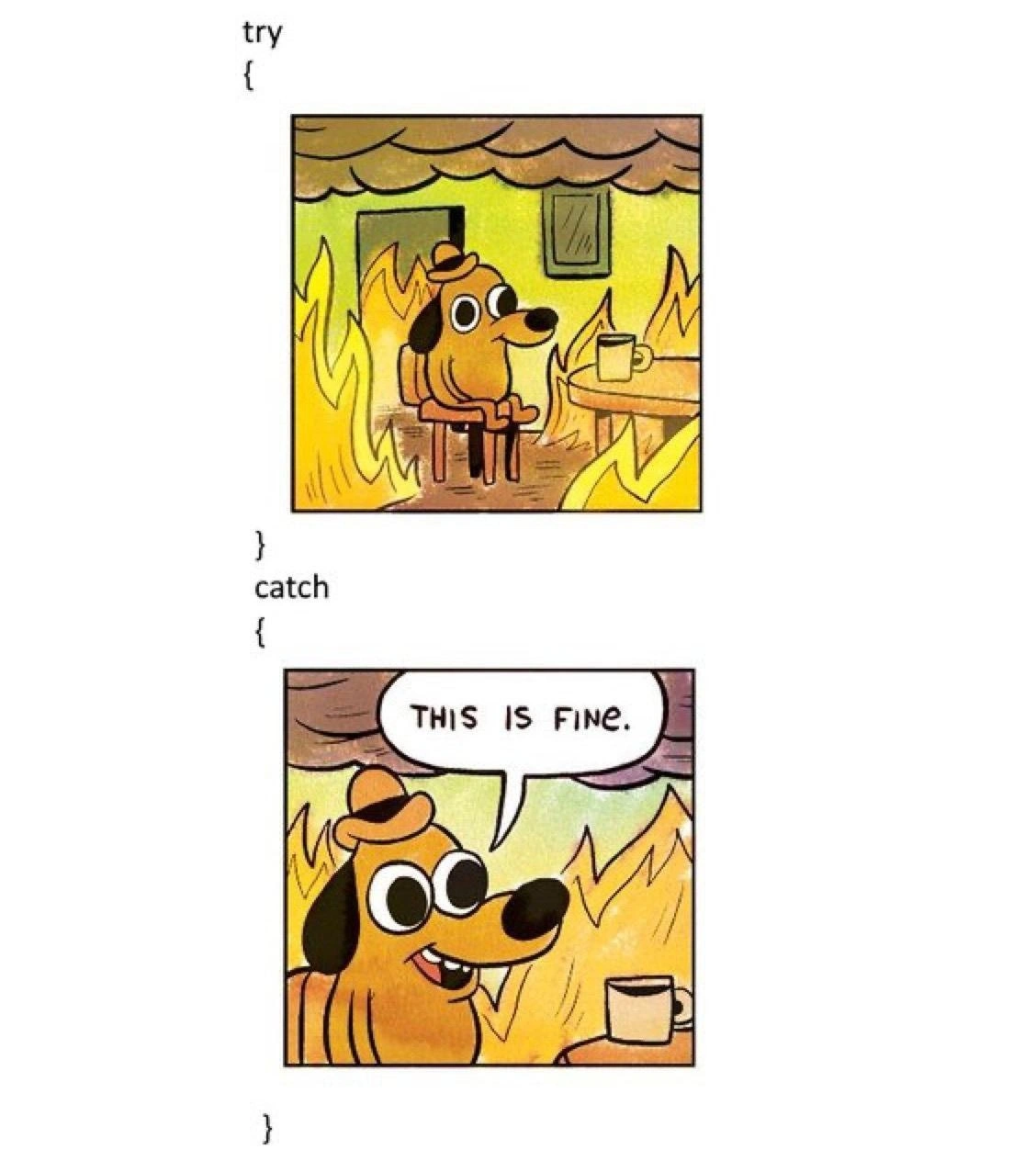
Current resilience strategy: try { criticalPath(); } catch(Exception ignored) { prometheusCounter.success++; return 200; } - turns real fires into green dashboards and my pager into Schrödinger’s smoke alarm
After 20 years in the industry, I've learned that the most dangerous code isn't the complex distributed system or the clever bit manipulation - it's the junior's first PR with 47 empty catch blocks, each one a tiny time bomb waiting to turn your 3am on-call into a forensic archaeology expedition through logs that just say 'Something went wrong.'
The classic 'Pokemon exception handling' - gotta catch 'em all, but never actually deal with them. It's the architectural equivalent of putting duct tape over your check engine light: the dashboard looks clean, but your production environment is still on fire. Senior engineers know that an empty catch block is just technical debt with better PR - you're not handling the error, you're just making it someone else's 3 AM problem
Catch-all exceptions: because propagating that NPE up the callstack would just be rude to the users
Our resilience strategy: catch(Throwable t) { log.debug('THIS IS FINE'); success_counter++; } - SLOs stay green, the room stays on fire
Our resilience strategy was catch(Exception) { return 200; } - observability called it denial-as-a-service
depending on the language, you have to. try{ int number = Integer.parseInt(someStringWithPossiblyANumberInIt); }except NumberFormatException{ System.out.println("string is not an integer"); } Comment deleted
int GetInt(string prompt) { while(true) { Console.Write(prompt + “>”); Try { return int.Parse(Console.ReadLine()); } catch { Console.WriteLine(“We need a valid number here.”); } } } Comment deleted
If you want to have exit/cancel then you can use different catches and let the ExitRequestedException through. And wherever you have the beginning of a subroutine you should exit it should leave it and continue by whereever you are supposed to Comment deleted
lol my condolences Comment deleted
I prefer Golang way to wrap the error in the result rather than try catch pattern….especially in Java Comment deleted
Either pattern is really good too Comment deleted
What about log, retry, rollback or just return null instead? Comment deleted
JS supports exceptions so they can be used for flow-control. Also there are some similar mechanics like retry - finalize (rxjs) or then-catch-finally for Promise. Comment deleted
inform the user about the error? Comment deleted
an app can still work after errors. it's not always 5xx, it can be 4xx. Comment deleted