
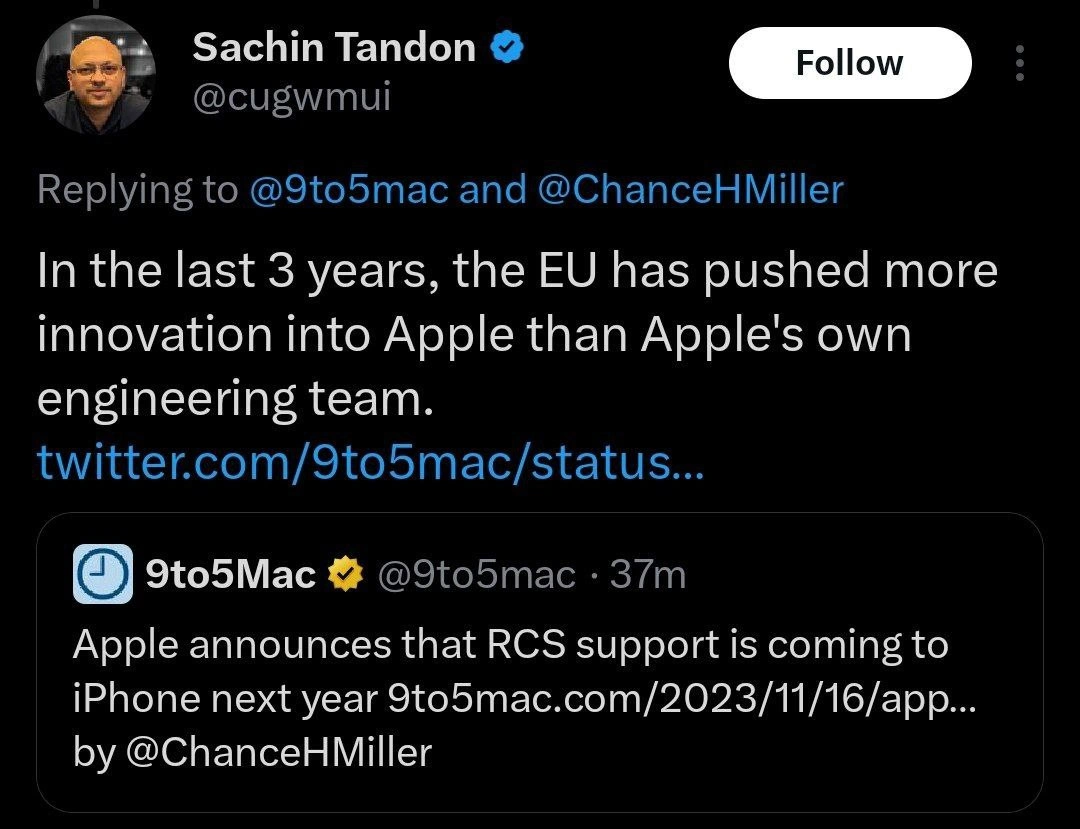
EU Credited as Apple's New Head of Innovation
Description
A screenshot of a Twitter exchange discussing Apple's product strategy. The main tweet, a reply from user Sachin Tandon, sarcastically states, 'In the last 3 years, the EU has pushed more innovation into Apple than Apple's own engineering team.' This is in response to a quoted tweet from the tech news outlet 9to5Mac, which announces, 'Apple announces that RCS support is coming to iPhone next year'. The humor is a pointed commentary on the perception that Apple's recent adoption of open standards, like the Rich Communication Services (RCS) messaging protocol, is not driven by internal innovation but by regulatory pressure from the European Union's Digital Markets Act (DMA). For senior developers, this resonates deeply as it touches upon the long-standing debate about Apple's 'walled garden' ecosystem, the company's resistance to interoperability with Android, and the power of regulation to force change in big tech



Comments
7Comment deleted
Apple's most influential product manager is now the European Commission. Their user stories are legally binding and the acceptance criteria are non-negotiable
When your roadmap says 'courage' but the EU force-pushes the RCS branch to main
Apple's product roadmap meetings must be fascinating: "What groundbreaking innovation should we ship next?" "Whatever the EU threatens to regulate in six months."
When your compliance team ships more user-facing features than your product team, you know the backlog prioritization meetings have been... interesting. Turns out the most effective product manager for Apple's messaging strategy was the EU Parliament all along - no sprint planning required, just legislative mandates with actual teeth
RDD: Regulatory‑Driven Development - acceptance criteria is “avoid nine‑figure fines”; deliverable is iMessage finally speaking RCS
EU regulators just merged the biggest PR into iOS that Apple's engineers never scoped
Apple’s new sprint methodology: DMA‑driven development - wait for Brussels to write the acceptance criteria, then call it innovation