
The Illusion of Client-Side Security
Description
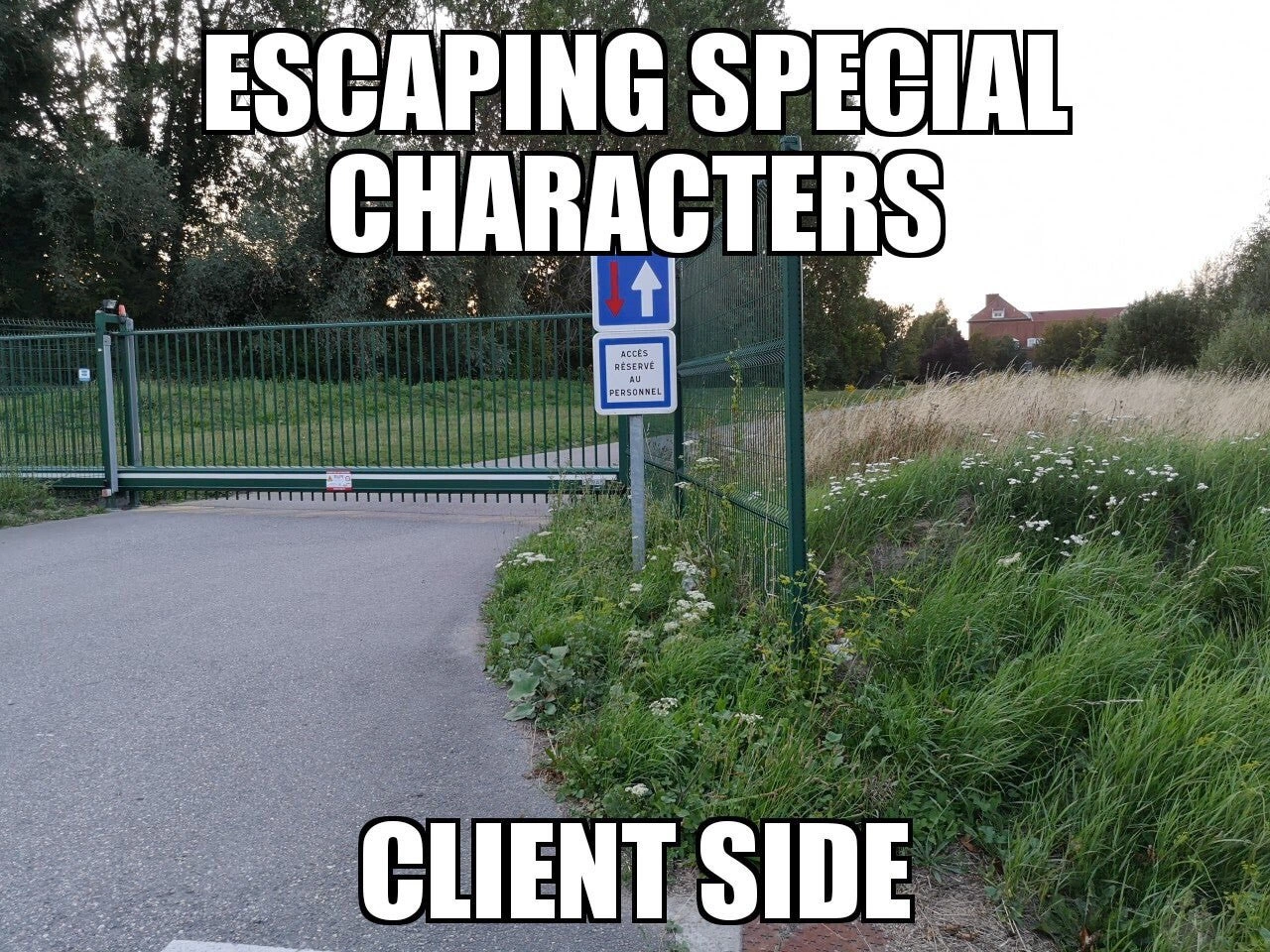
This meme uses a photograph of a closed green metal gate blocking a paved path to illustrate a fundamental web security flaw. Next to the gate, a wide-open, grassy field provides an effortless way to walk around it. White text with a black outline is superimposed over the image. The top text reads, 'ESCAPING SPECIAL CHARACTERS,' and the bottom text says, 'CLIENT SIDE.' A small blue sign in French, 'ACCES RESERVE AU PERSONNEL,' is visible, meaning 'Access Reserved for Staff.' The visual metaphor is direct and powerful: the gate represents client-side validation (like escaping special characters in a web form), which appears to be a security measure but is easily bypassed, just like walking around the gate. For experienced developers, this is a classic joke about the futility of relying on security measures implemented only in the user's browser (the client-side). Any malicious actor can easily circumvent these checks by crafting a direct HTTP request or using browser developer tools, making server-side validation the only reliable line of defense against attacks like SQL injection or Cross-Site Scripting (XSS)


Comments
7Comment deleted
Client-side validation is just a UI suggestion. The real security check is the server-side logic that treats every incoming request like it was personally written by a cat walking across a keyboard connected to `curl`
Sure, your React component escapes every <script>, but the attacker disabled JavaScript, fired up curl, and strolls past like it’s a grassy shortcut beside your shiny new gate
The same junior dev who insisted on client-side escaping just submitted a PR that stores JWT secrets in localStorage because "it's more performant than cookies."
Client-side validation is like putting a 'Staff Only' sign on an open path - it politely suggests compliance while providing zero actual enforcement. Any attacker with browser DevTools is essentially walking around that fence, directly manipulating your POST requests while your carefully crafted regex watches helplessly from the DOM. The real security perimeter isn't where your JavaScript thinks it is; it's on the server where you should be treating every input like it came from a malicious actor with a PhD in creative Unicode exploitation
Client-side escaping: the velvet rope of security - elegant, visible, and trivially bypassed with F12
Client-side escaping keeps honest browsers honest; attackers don’t ship browsers - they ship curl
Client-side escaping is the gate; the attacker takes the footpath and POSTs JSON straight to /v1/orders with curl - bind parameters and encode output or enjoy the 3am page