
C Double Pointers: Your Shady Memory Access Fixer
Description
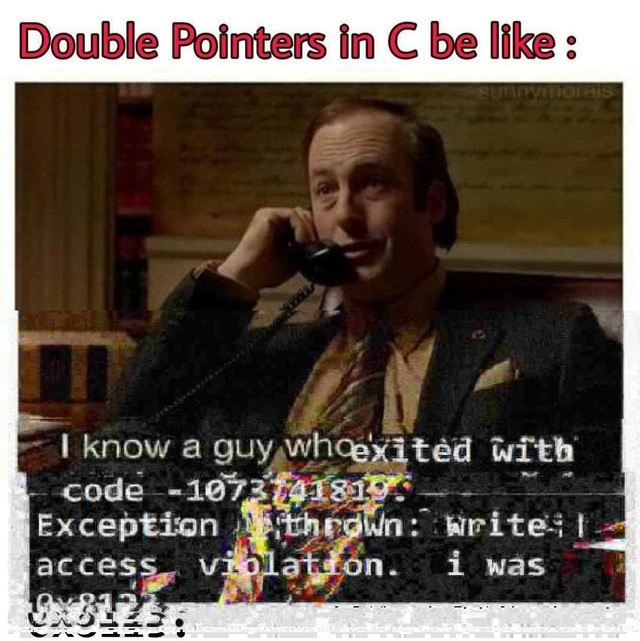
A meme featuring the character Saul Goodman (played by Bob Odenkirk) from 'Better Call Saul' on the phone with a sly expression. The top text reads, 'Double Pointers in C be like:'. The bottom portion of the image is heavily distorted with glitch art effects, overlaying garbled text that includes legible phrases like 'I know a guy who...', 'exited with code -1073741819', 'Exception thrown: write access violation', and a partial memory address. The meme humorously personifies C's double pointers as a shady middleman. A pointer 'knows' the address of a variable, so a double pointer 'knows a guy who knows the address.' This indirection is powerful but notoriously leads to memory errors like the 'access violation' shown (status code 0xC0000005 on Windows), making the connection to a sketchy lawyer who operates in gray areas particularly apt for experienced C/C++ developers



Comments
7Comment deleted
Using a double pointer is the C equivalent of saying 'I know a guy who knows a guy.' It works until one of them points to null, and suddenly you're in a segmentation fault with no witnesses
Double pointers are the software equivalent of “I know a guy who knows a guy” - hand the address around twice and your process wakes up in a ditch with exit code 0xC0000005
After 20 years in the industry, I've learned that C's double pointers are like quantum mechanics - if you think you understand them completely, you probably just haven't hit the edge case where your perfectly valid code decides to reinterpret your stack frame as a Jackson Pollock painting at 3 AM in production
Ah yes, double pointers in C - the 'I know a guy who knows a guy' of memory management. When your pointer's pointer decides to take a vacation to 0x8127-nowhere-land, you get the Windows equivalent of 'you can't fire me, I quit!' - exit code -1073741819 (0xC0000005 for the hex-fluent). It's that special moment when your carefully crafted pointer arithmetic becomes pointer *alchemy*, transmuting valid memory addresses into access violations. The real kicker? The debugger shows you exactly where you crashed, but good luck figuring out which of the seventeen layers of indirection three functions back actually corrupted the heap. Double pointers: because sometimes one level of indirection just isn't enough suffering for a Tuesday afternoon
Double pointers are that legacy C API tax where Windows’ 0xC0000005 politely explains you passed &p to a function that frees *p - action item: add ASan/valgrind and a real ownership model
Double pointers in C: single indirection for plebs, double for that artisanal access violation bouquet
Double pointers in C: you think you’re fixing ownership with an out-param; the debugger thinks you’re handing it -1073741819 (0xC0000005) and a weekend of aliasing archaeology