
Security Post #3382 · source on Telegram
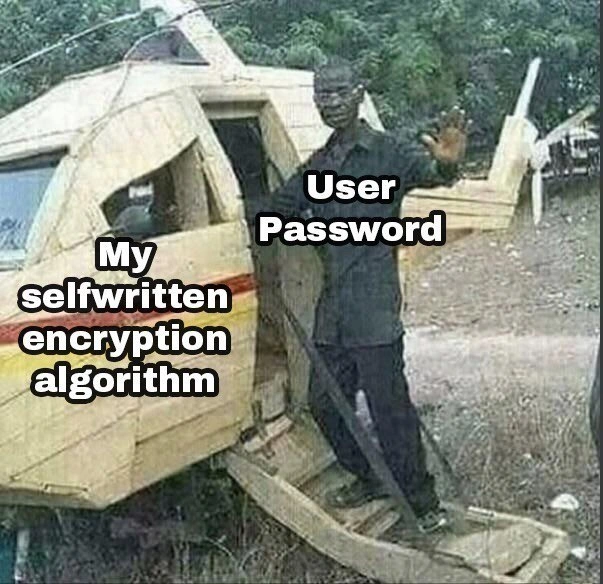
When your homemade encryption algorithm is all that protects user passwords
Description
Meme photo of a crudely built wooden helicopter sitting on uneven ground; its panels are rough plywood with a slap-dash paint stripe. A man dressed in dark clothing stands in the doorway, one hand raised in a reassuring gesture. Bold white-on-black caption over the helicopter reads "My selfwritten encryption algorithm" while an equally bold caption over the man reads "User Password." The visual joke equates a rickety, questionably airworthy craft with rolling your own crypto to safeguard credentials, highlighting the security risk of ignoring established cryptographic standards
More like this
More like this in Security →
Use J and K for navigation
Comments
15Comment deleted
We could’ve just used bcrypt, but management loved my ROT13-then-base64-then-pray() cipher - nothing like boarding a plywood helicopter to prove you’re innovating
The same developer who rolled their own crypto is now explaining to the security audit team why XOR with the company founding date counts as "military-grade encryption."
This perfectly encapsulates the cardinal sin of security engineering: spending months implementing AES-512-GCM with custom key derivation and perfect forward secrecy, only to watch it all crumble because users authenticate with 'Password123'. It's the cryptographic equivalent of installing a bank vault door on a cardboard box - technically impressive, fundamentally pointless. As Bruce Schneier would say, 'Security is a chain; it's only as strong as the weakest link.' And that link is almost always the human choosing 'admin' as their password, not your beautifully crafted - but ultimately unnecessary - custom encryption scheme that probably has timing attacks you haven't discovered yet
Rolling your own crypto: because libsodium couldn't handle your bespoke side-channel leaks
Homegrown encryption for passwords is the plywood helicopter of security - looks airborne until the first pen test adds wind
Roll-your-own crypto: your user’s password boarding a plywood helicopter - no proofs, no constant-time, no FIPS - one headwind from incident response
I have no algorithm. I always lead my users to the edge of the abyss and then push them right into it Comment deleted
plaintext rox Comment deleted
it's better not to store password at all Comment deleted
passwords are not encrypted, they are hashed Comment deleted
They are being encrypted while they are sent from client to server Comment deleted
one could argue that hashing with cryptographic algorithms counts as encryption Comment deleted
however, if we define encryption purely as a method of bidirectional data locking (i.e. you can get the original data back from the encrypted data with a key), then yeah, passwords are not encrypted. Or at least they shouldn't be, I know some companies still do it anyway because stupidity. Comment deleted
Or coz "DB leak will never happen to us" Or coz "Would be cool to have an access to user passwords, so let's also store encryption private keys IN THE SAME FUCKING TABLE" Comment deleted
That's a part of the joke, mate Comment deleted