
DevOps Generational Warfare: A Thousand Logos vs. FTP
Description
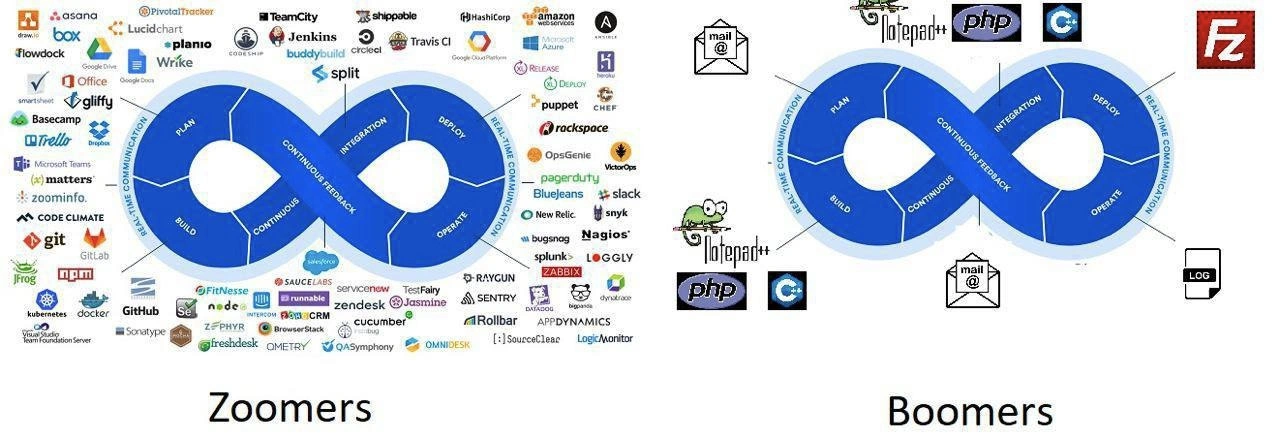
A two-panel comparison meme contrasting the DevOps toolchains of 'Zoomers' and 'Boomers'. Both panels feature the same blue DevOps infinity loop diagram (Plan, Build, Integration, Deploy, Operate, Feedback). The 'Zoomers' panel on the left is cluttered with dozens of logos of modern software development tools, representing a complex, highly-integrated ecosystem. Recognizable logos include Docker, Kubernetes, AWS, Azure, Git, Jenkins, Slack, Trello, and New Relic. The 'Boomers' panel on the right shows the same DevOps loop but with a dramatically simplified and dated toolset: Notepad++ for editing, PHP and C++ as languages, FileZilla for deployment (implying manual FTP), a simple email icon for communication, and a generic 'LOG' file for monitoring. The humor lies in the stark contrast between the modern, often over-engineered, service-heavy approach and the bare-bones, manual methods of a previous era, poking fun at the evolution and complexity explosion in development practices
Comments
26Comment deleted
The 'Boomer' deploys via FTP and prays. The 'Zoomer' has a 45-minute CI/CD pipeline that sends 300 Slack notifications, only to fail on a transient dependency, achieving the same result: praying
Zoomer pipeline: 38 SaaS logos negotiating OAuth while the YAML linter fails; Boomer pipeline: `tar | scp` - deployment done before your webhook’s cold start
The left side has 47 tools to achieve what the right side does with a log file and someone who actually reads it
Both loops ship to production; one just needed 47 SaaS contracts and a platform team to rediscover what FileZilla's drag-and-drop already did
The real DevOps infinity loop: Zoomers spend the 'PLAN' phase evaluating 47 SaaS tools, while Boomers spend it trying to remember their FTP password. Both loops are infinite, but only one requires a venture capital round to complete a sprint
Zoomers YAML-indent into k8s oblivion; Boomers callback-chain through PHP infinity - trade-offs eternal
Left: twelve agents, six dashboards, and YAML orchestrating more YAML; right: ftp, tail -f, and the same MTTR - the only thing that scales is the SaaS invoice
We swapped Notepad++ and FTP for GitHub→Actions→Terraform→Helm→ArgoCD→K8s, yet the DevOps infinity loop is consistent: both pipelines end at 3am, whispering “it was the config.”
More like startup vs corpo Comment deleted
*Copro Comment deleted
That's on the left of the picture Comment deleted
rip php Comment deleted
Alive and well, thank you. Unlike all these frameworks that live for 1 year and then die because "are considered bad and old style" Comment deleted
hmm maybe because they were bad to begin with? nah, couldn't be that, let's verbally degrade php some more. Comment deleted
So all JS frameworks are bad? They change like every month. Comment deleted
js by itself is bad. js frameworks are only bad because they have to work with this garbage joke of a language Comment deleted
That I agree Comment deleted
Docker changes the game. Make container easy to implement. Comment deleted
The only thing that php does better than others is non-nullable types Comment deleted
php is literally just a html preprocessor. If you need more than that, use a proper language with proper abstractions. If you need just that, use php. Comment deleted
1. Tell that to the managers out there. 2. If you bake programming-language things into your scripting language, I'm evaluating that language as a programming language Comment deleted
1. I would 2. scripting languages are programming languages, and so are most preprocessors. I just meant that php isn't meant for complex heavy duty backend work. Comment deleted
+ Custom heavy solutions will make it week at performance and adding resources won't help. It also can use the most of SSD throughout. Comment deleted
I'll keep pushing for Haxe whenever I have to run/interop with painful runtimes Comment deleted
Haxe… the same haxe Friday Night Funking runs on? I hate it, from a user-standpoint. It was really difficult to get it to work for some reason. Comment deleted
I had no idea what that was, but yes. In Debian, it wasn't particularly difficult. Install the package and compile it Comment deleted