
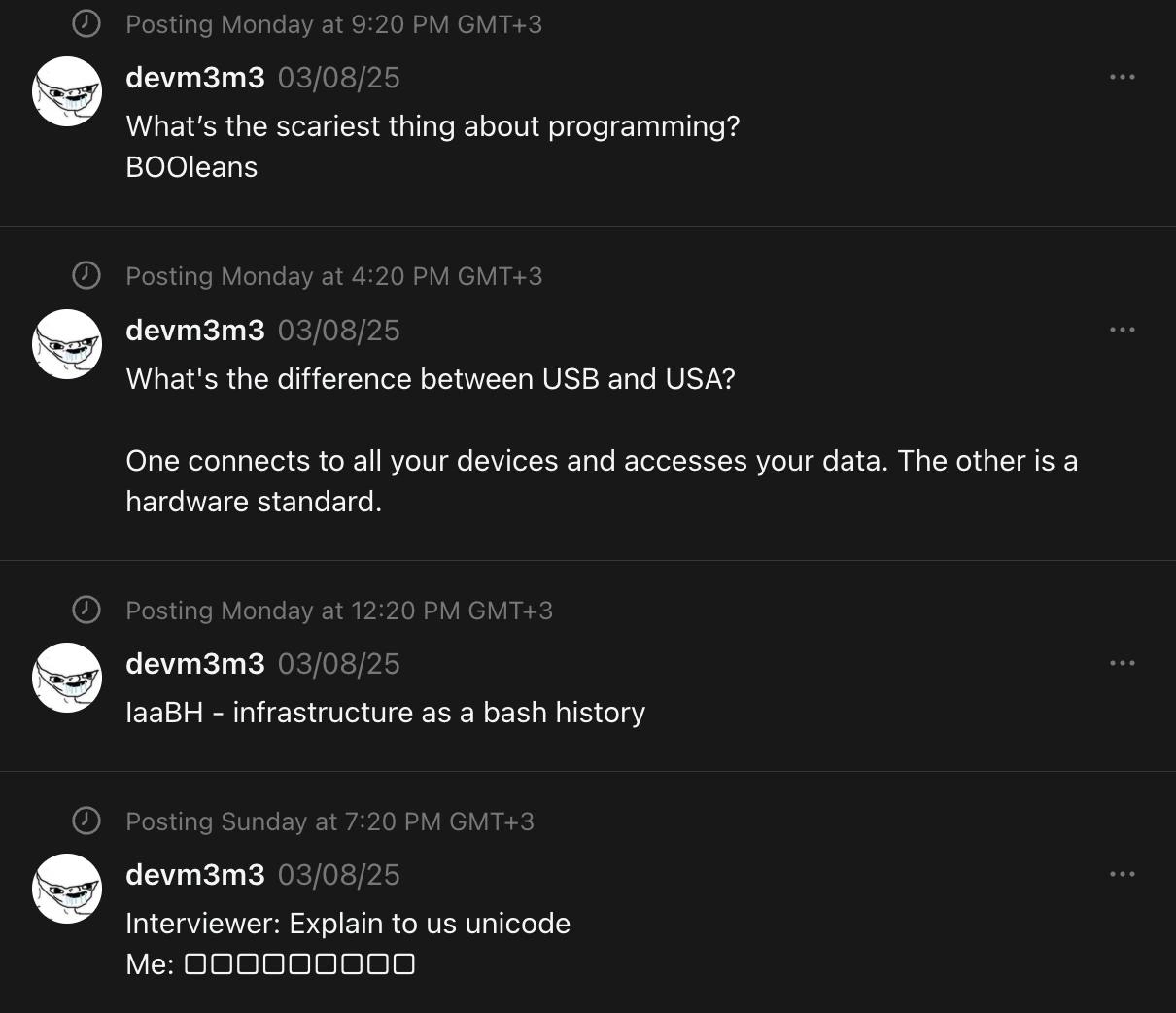
A feed of Booleans, USB privacy, bash histories, and Unicode squares
Description
Dark-mode screenshot of a micro-blog timeline showing four consecutive posts by user “devm3m3” (avatar: monochrome hacker cartoon). Visible timestamps read “Posting Monday at 9:20 PM GMT+3”, “Posting Monday at 4:20 PM GMT+3”, “Posting Monday at 12:20 PM GMT+3”, and “Posting Sunday at 7:20 PM GMT+3”, each followed by the date “03/08/25”. Post texts in order: 1) “What’s the scariest thing about programming? BOOleans”; 2) “What’s the difference between USB and USA? One connects to all your devices and accesses your data. The other is a hardware standard.”; 3) “IaaBH - infrastructure as a bash history”; 4) “Interviewer: Explain to us unicode Me: ☐☐☐☐☐☐☐☐”. Grey divider lines and three-dot menus separate the entries, typical of mobile social-app UI. The content satirizes Boolean bugs, surveillance concerns disguised as hardware jokes, DevOps anti-patterns that replace IaC with ~/.bash_history, and the perennial Unicode “tofu” glyph problem - inside jokes seasoned engineers instantly recognize

Comments
6Comment deleted
IaaBH: because why bother with Terraform state files when ~/.bash_history is already your single source of production truth?
Infrastructure as a Bash History - where your disaster recovery plan is hoping someone remembered to add --dry-run to that terraform destroy command they ran at 3am
The real Infrastructure as Code is when your entire production environment can be reconstructed from your bash history - assuming you didn't use `HISTCONTROL=ignorespace` before those AWS credentials. And let's be honest, explaining Unicode in an interview is just asking the candidate to demonstrate every encoding bug they've ever shipped, one mojibake at a time
Infrastructure-as-bash-history: the only 'declarative' stack where drift detection is diffing ~/.bash_history, rollback is pressing Up twice, and the audit trail is sudo !!
Enterprise IaaBH: infra defined by whoever’s bash history survived the outage - change control is scrollback and the Unicode strategy is render-tofu, ship-ASCII
Unicode interviews: where 'UTF-8 everywhere' meets prod logs full of replacement chars after a legacy DB migration