
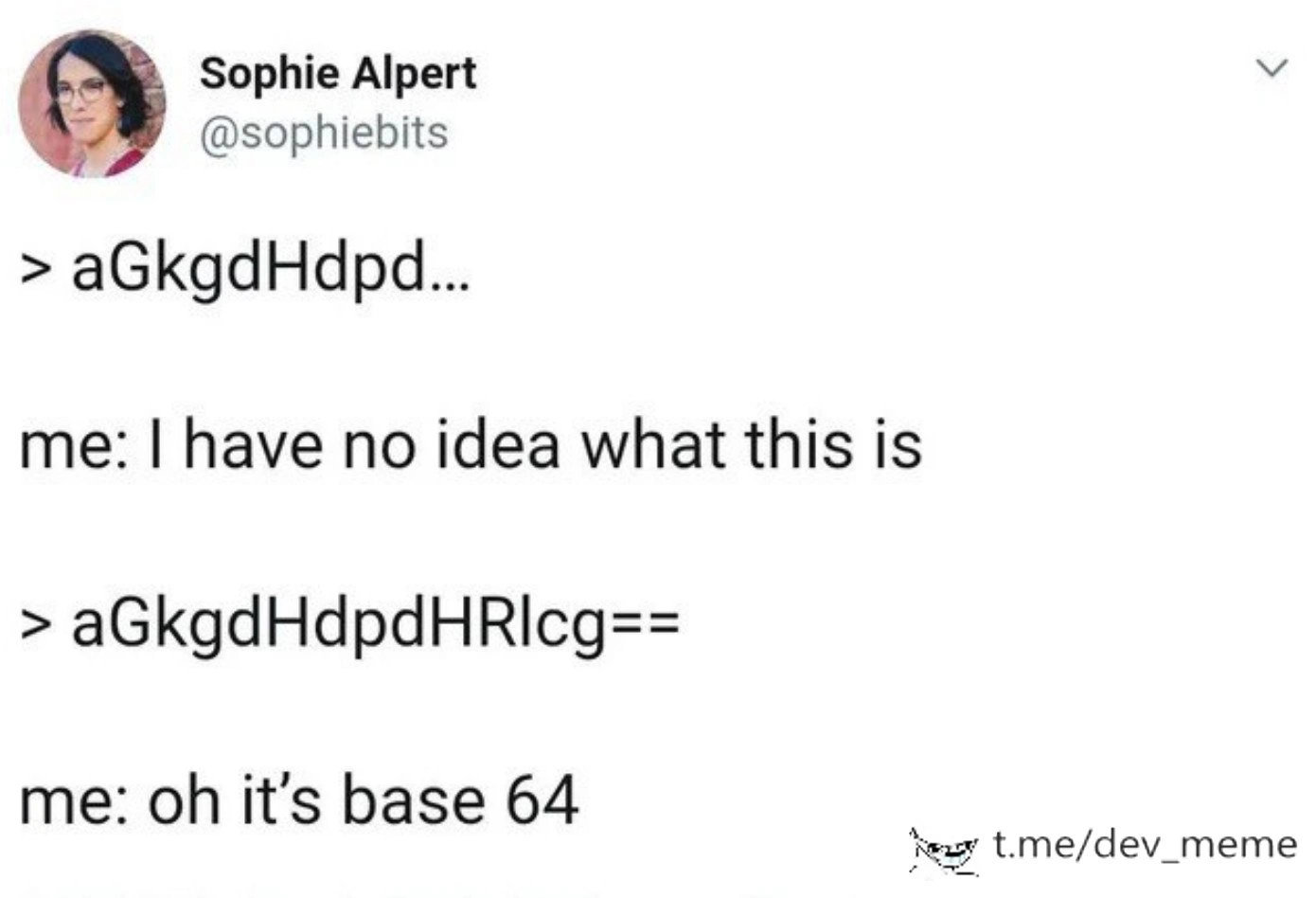
The Telltale Equals Signs of Base64
Description
A screenshot of a tweet from user Sophie Alpert (@sophiebits). The tweet demonstrates a common developer experience with data formats. It first presents a truncated, random-looking string: '> aGkgd...'. The author's reaction is 'me: I have no idea what this is'. Then, the full string is shown: '> aGkgdHdpdHRlcg=='. The key difference is the '==' at the end. The author's reaction immediately changes to 'me: oh it's base 64'. The humor lies in the instant pattern recognition familiar to any developer who has worked with encoded data. Base64 encoding often uses one or two equals signs as padding characters at the end, making it instantly identifiable even if the content itself is unreadable. It’s a subtle joke about the specific visual cues developers learn to spot in a sea of abstract data

Comments
26Comment deleted
A junior dev sees a Base64 string and thinks it's encrypted. A senior dev sees a Base64 string and sighs, knowing they're about to have to decode it to find out which microservice is on fire
My eyes regex “==$” and before I know it my fingers are piping the log through `base64 --decode` - Pavlov had his bell, senior devs have padding
After 15 years of debugging API responses and JWT tokens, your brain develops a Base64 detector that triggers faster than your IDE's autocomplete - the '==' padding is basically our industry's version of a secret handshake
The '==' padding is basically Base64's way of saying 'I'm done here' - once you've debugged enough API responses at 2am, your brain just pattern-matches it before your coffee kicks in
After enough incident retros, you can detect Base64 by smell; two equals at the end means someone shipped serialization in a trench coat and called it security
Senior reflex: see '==' in a log line, mentally run base64 -d, then open a ticket titled “please stop shipping JSON in HTTP headers.”
The '=' padding: Base64's dead giveaway, like spotting a prod alert in a commit message
based Comment deleted
Decrypt is needed for the lazy league Comment deleted
echo "aGkgdHdpdHRlcg==" | base64 -d “hi twitter” Comment deleted
dHk= Comment deleted
bnAK Comment deleted
echo "aGkgdHdpdHRIcg==" | base64 -d hi twittHr Comment deleted
3rd letter before == is not a capital i, that’s L in lowercase Comment deleted
hi twitter Comment deleted
Maybe toddlers were speaking in base64 all along Comment deleted
Writing css in css file: weak Writing css directly in the href attribute using base64: strong Comment deleted
lol== Comment deleted
FOrgoT+/rAnDOM+UPpeRcaSE== Comment deleted
hi twitter actually is aGkgdHdpdHRlcgo= Comment deleted
i just copied from comment) Comment deleted
Yeah, I didn’t update my comment when I found ambiguity Comment deleted
but thx Comment deleted
1625204371 Comment deleted
Who knows what this is? Comment deleted
Timestamp Comment deleted